Tag Archives: St. Andrew Catholic Church (Milford, Ohio)

Awkward: yes. Complain: no

30 Oct


“That was awkward,” is okay. “I don’t like that,” is not okay.

That is my rule for myself until May 27, six months from November 27.

On the First Sunday of Advent, November 27, the new English translation of the Mass will be used for the first time. There will inevitably be awkward moments. It will be okay to note them. It might even be good to celebrate them. But it will not do much good to complain about them.

In the new translation some of the wording in the prayers, dialogues and responses will be slightly different from the wording that we Catholics, and we Catholic priests, have used for the last forty years, or for as long as you have been alive, if you are not yet forty years old. It will be okay to point out the awkwardness, to share the awkwardness with a smile and maybe even with a laugh. But complaining will not help us to make progress or to be prayerful.  

My new rule – a rule for myself – will be: “No Complaining for Six Months.” We priests, maybe more honestly I should say, this priest (I) can be quick to say what I like and what I don’t like about the new translation of a word or phrase that we will use. But I would do well just to pray, using the words that the Church gives us to pray, and not analyze, object or change any word that is in that brand new Roman Missal that arrived in the mail a couple weeks ago.

So, if another priest or a parishioner complains, I must listen, but I do not need to join in, further or add to the complaint.  Perhaps in six months I will look back and discover that what was awkward is no longer so, and what I did not like, I like. Even if not, what the Church has given me to pray as a priest at Mass, I will pray at Mass.

You may want to stay away from me on May 28, when my rule expires. But let us hope that on May 29 all will be well.  

آمين‎ and Amen

23 Oct

The message was one of HOPE. The prayer was for PEACE.

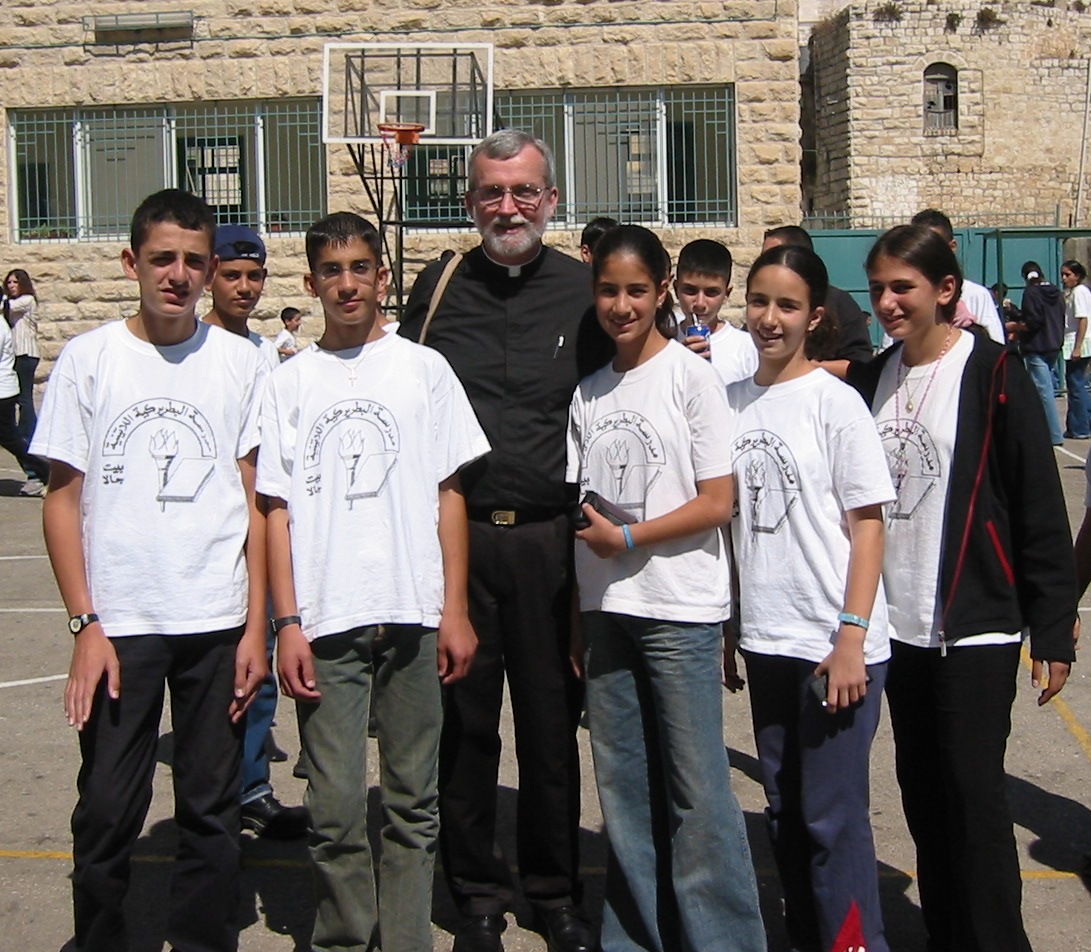
This time the children of our Catholic school at St. Andrew-Saint Elizabeth Ann Seton prayed the rosary not just “for” our sisters and brothers in the Holy Land. They prayed “with” their brothers and sisters of the Holy Land, during the visit of four Palestinian teachers from the Holy Land.

Each decade of the rosary on the wall and in their hands was a different color. For each decade there was a different intention and reflection. 

The first mystery of the five decade rosary was the “Visit of the Magi.” The color was green. The symbol was hope. The language was English.

The second mystery was “Jesus Speaks with the Samaritan Woman.” Appropriately, it was prayed in Arabic by the teacher from Nablus, the site of Jacob’s well, from which the teacher and her students still drink. The symbol was peace and unity; the color was blue.

Back to English, the third mystery, “Jesus Cures the Centurion’s Servant,” with white being the color, carried with it a message of healing, light and understanding.

The teacher from Beit Jala (Bethlehem) led the fourth mystery, “Jesus Sends Out His Disciples,” with its symbol of the Holy Spirit and its color of red.

The children finished with the fifth mystery in English, “The Conversion of Paul.” The yellow beads of the decade brought with them thoughts of optimism and joy.

At the end of each Our Father, Hail Mary and Glory Be there was an Amen, heard in English and in Arabic. The sound of “Amen” in English is not much different from the sound of “Ameen” in Arabic. In the praying, the children realized that the teachers from the Holy Land were not much different from the teachers in their own classrooms. The visiting teachers probably saw in the faces and voices of our students the hopes and dreams of their own students back home in Nablus and Beit Jala.  

آمين and Amen.

Consider This Clermont: Palestinian Educators

23 Oct

Thank you, Theresa, Kellie and John!

Our local “Milford-Miami Advertiser” reported twice, with photos, on the visit of the Palestinian Educators to Milford. Enough thanks cannot be given to Theresa Herron, editor, and to reporters Kellie Geist-May and John Seney. They and their Community Press could not have done more.  

photo: John Seney/The Community Press

Palestinian educators share experiences” by John Seney was published on October 13, with accompanying photos of the children and classrooms of the St. Andrew campus of SASEAS school. Take a look and read by clicking on the title.

 photo: John Seney/The Community Press

Palestinian educators to partner with Milford, Cincinnati teachers” was published on September 23. Clicking on the headline will take you to Kellie Geist-May’s article.

photo: John Seney/The Community Press

If you want to express your appreciation, here are their email addresses: therron@communitypress.com
(Theresa Herron), kmay@communitypress.com (Kellie Geist-May) and jseney@communitypress.com
(John Seney).

You-Me and Me-You

12 Oct

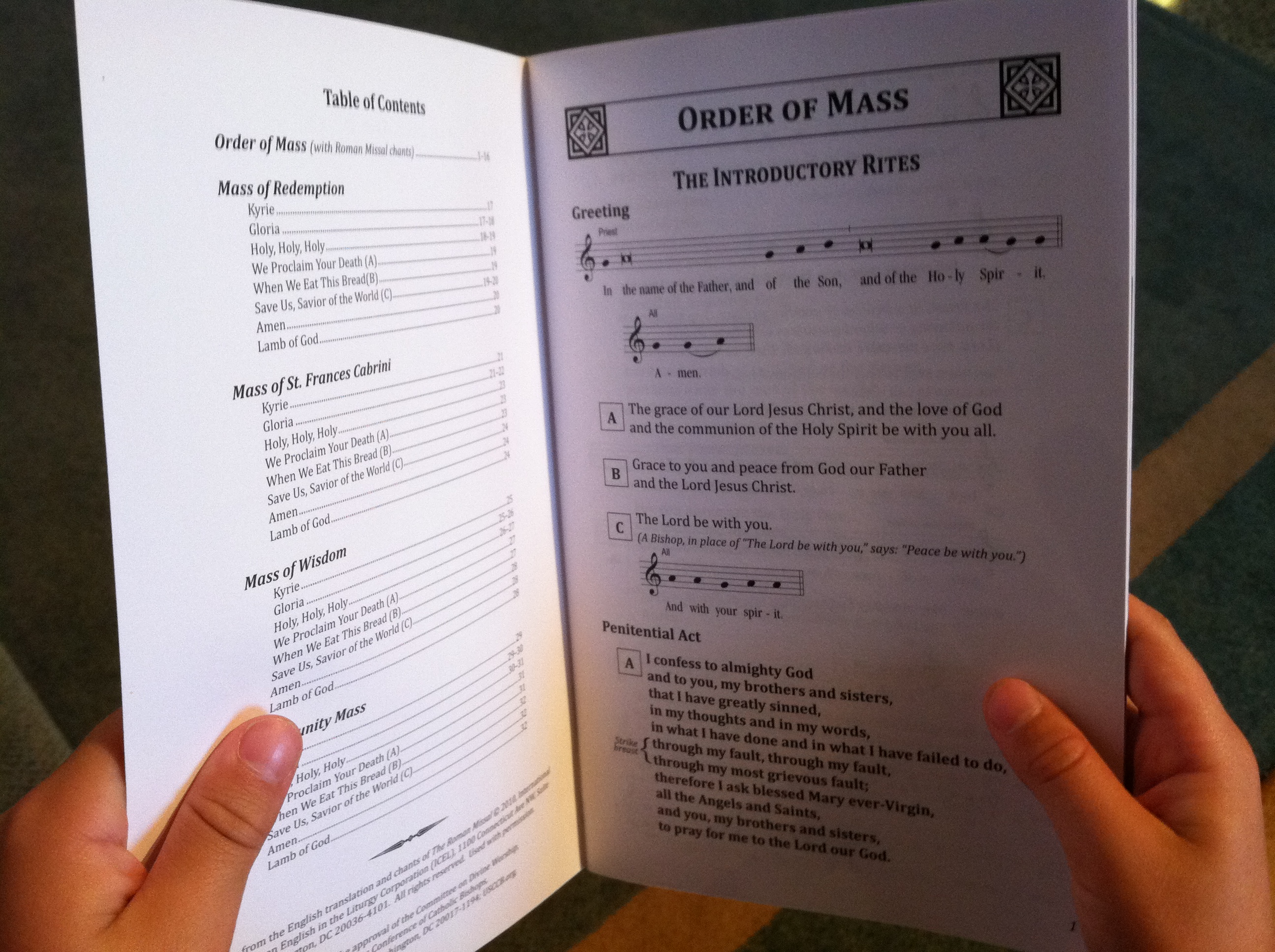
It was prepared by our local Worship Office, after extensive and comprehensive study and recommendations from Music Directors throughout the Archdiocese. You find it in the pew near you. The red booklet, “Revised Order of Mass with Additional Mass Settings,” will help us help each other. Notice that I say, “help each other.” I will help you, and you will help me. That is how we do things here at St. Andrew.

This weekend we begin singing the Holy, Holy, Holy (Sanctus) and the Memorial Acclamation (The Mystery of Faith) from the Revised Mass of Redemption. By the time we publicly and officially open the new Missal, we will be comfortable with the “new” words as sung in the Mass of Redemption.

During the homily at all the Masses on the weekend of November 13, Deacon Tim will introduce us to the new chants that will be sung every Sunday before and after the Gospel reading, and to the chanted dismissal at the end of Mass.

At all the Masses on the weekend of November 20, I will use the homily time to point out and to sing with you a “few of my favorite things” from the new Missal, which you will find in the red booklets. We will also bless the Missals for their first use on the next Sunday.


Andrew Got the Red Ribbon

12 Oct

The Roman Missal arrived just yesterday. Still in its packaging, it was begging for me to do something. What I decided to do was to let the school children open it

Today, at Mass with the 6th, 7th and 8th graders of our school, I volunteered the two students with a date of birth or a date of baptism closest to November 27 to open the package. For me the suspense was building, as I told them, “I haven’t seen it yet myself. The pages are going to be crisp. The binding and cover will be unblemished, no fingerprints or marks. The colored ribbons will be bright and ironed. The words will be fresh. The music is going to want to sing itself right off the page.” 

Standing on the sanctuary steps with their religion teachers and their music teacher, and with the music director and the deacon of St. Andrew parish, Kyle and Claire removed the outside plastic wrap. Inside the box they found the Missal covered with another coat of clear wrap. “Should we open it?” they asked. “Of course! It’s so big. Is it heavy?”   

The edges of the pages were gold. As they held it, they let me open it up to look inside. The book opened to the feast of the Annunciation. A full size picture was in color. The first letter of paragraphs of the prayers were capitalized and decorated. We found the feast of St. Elizabeth Ann Seton and put a ribbon at that place. St. Andrew, on November 30, got the red ribbon, being an Apostle.

The Church has given us a great big gift. Today at St. Andrew-St. Elizabeth Ann Seton we received the gift and opened it. Kyle took it into the sanctuary and opened it up on the altar. We are ready for Kyle’s birthday. I mean, we are getting ourselves ready – and are getting anxious – for the First Sunday of Advent to arrive.

The new English translation of the Roman Missal, Third Edition has arrived and is in our custody. We love it!  

Christians 750, Samaritans 700, Muslims 344,550

7 Oct

photo credit: Mark Bowen/HOPE

They begin their presentation about their Catholic school by saying that there are 650 students, including 61 Christians and 4 Samaritans. “What? There are Samaritans in your school? … and only 61 of the 650 children in your school are Christians? … and it’s a Catholic school?” They have our attention.

The two Palestinian educators, the principal and an English teacher to 1st and 6th graders, are from Nablus in the West Bank. Nablus is the home of Jacob’s well. Remember Jacob’s well, where Jesus asked the Samaritan woman for a drink? Miss Abeer and Miss Ruya, and the people of Nablus, still drink water from that well. And there are still Samaritans in their town, 700 of them, which is almost all of the Samaritans left in the whole world. In a total population of 346,000 that is not a big number, but neither is the number of Christians: 750. Christians and Samaritans are obviously in the minority among the majority, the people of the Muslim faith.

There are four priests in Nablus: Greek Orthodox, Greek Catholic, Roman Catholic and Anglican. The fact that there are four churches is an indication that once there were many Christians in Nablus.

Nablus is known in the West Bank for its sweets and its soap. The Catholic school at which Miss Abeer is the principal and at which Miss Ruya is a teacher is also well-known for the excellent education it provides for all the children, Catholic, Muslim and Samaritan, who come through its doors and into its classrooms, whether or not their families have the money to pay the tuition.

Along with an olive wood cross with images of the Stations of the Cross, Miss Abeer and Miss Ruya brought me a box locally made soap. The sweets will be waiting for me when I make a return visit to their homes, their school and their city of Nablus in Palestine.

photo credit: Mark Bowen/HOPE

Nothing as Sacred as Home

6 Oct

photo credit: Mark Bowen/HOPE

After our visit with Archbishop Dennis Schnurr and two of his office directors, Dr. Mike Gable (Missions) and Dr. Jim Rigg (Education), to thank the bishop and to receive his blessing, we went to the National Underground Railroad Freedom Center. It took visitors from 6,000 miles away to take me to a museum in my hometown. 

photo credit: Mark Bowen/HOPE

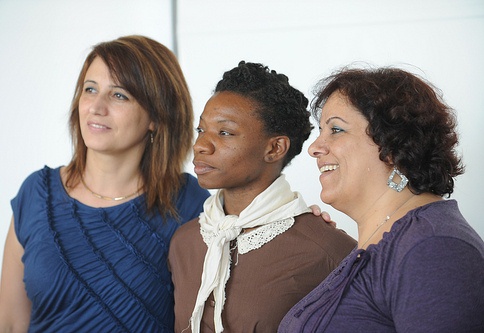
Sitting on a bench with real-life Palestinians “in the home” of a “slave,” as an actress, playing the part, welcomed us into her home for a rest from our journey and told us her story, I was wondering whether or not my guests were hearing their story in hers. Her advice to us was remarkably applicable to them, “You’re on a journey – and you’ll get there. You hold on to family! This is my home. This is my home. There is nothing in the whole world as sacred as home. It’s time for you to go home now.”

After the presentation, we snapped a photo of three women – the “slave” and two Palestinians, one from Nazareth carrying an Israeli passport and the other from the West Bank carrying a Palestinian passport. Three women, on a journey toward rights and freedom, holding on to family, with nothing as sacred as home – how alike they were!

photo credit: Mark Bowen/HOPE

Shokran … Afwan

5 Oct

photo credit: Mark Bowen/HOPE

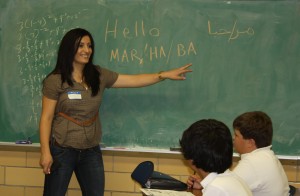
A lot of Arabic was heard in our classrooms and hallways today at St. Andrew-St. Elizabeth Ann Seton School. “Marhaba (hello) … Shokran (thank you) … Afwan (you’re welcome),” were coming from all our K-8 students, punctuated with grins and hugs.

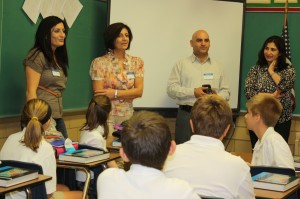
Our visitors were teachers from Catholic schools in Beit Jala and Nablus in the West Bank. Guided through our school by our principal, the Christian teachers glided into rooms of children, as if they were walking in on groups of their own students back home in Palestine.

The children were all eyes and ears, as they learned that, yes, in the Catholic schools in the Holy Land, children wear uniforms and play soccer, that they go to school on Saturday, but not on Friday and Sunday, and that many of their classmates are Muslims.

After being asked by Miss Abeer and Miss Ruya whether they knew the Bible story about the Good Samaritan, and about Jesus meeting a Samaritan woman at Jacob’s well and giving her a drink, the children seemed amused that people in Nablus still drink from the same Jacob’s well and that there are six Samaritan children in the Catholic school.   

The children were impressed when Miss Eman and Mr. Waseim told them that Beit Jala was right next to Bethlehem, and that they lived where Jesus was born. But they did not like hearing that the students in Beit Jala could not go on field trips because of a high wall that has been built around their town to keep them in. They were puzzled when they heard that, if the first Christmas took place today, Mary and Joseph wouldn’t be able to get into Bethlehem because 0f that high wall.

photo credit: Mark Bowen/HOPE

You Raise My Head

4 Oct

On this date eight years ago I first met Issa, Tamer, Tamara, Ranim and Mary in the schoolyard in Beit Jala. I had gone to the Bethlehem-area school to meet their families to give them my assurance that we would take care of their children. I thanked the five sets of parents for trusting me with their 8th graders, the youngest of them just 12 years old.

The Palestinian Christian children left their homes in the West Bank, came to Milford, stayed for just six weeks, and changed my life forever. They are all now back home, in their fourth year of college. I am as proud as any grandparent could ever be.

Happy anniversary, kids. I wish that I could say it to you in Arabic, but this is the best that I can do …. You raise my head!

Halo Around the Moon

4 Oct

photo credit: Mark Bowen/HOPE

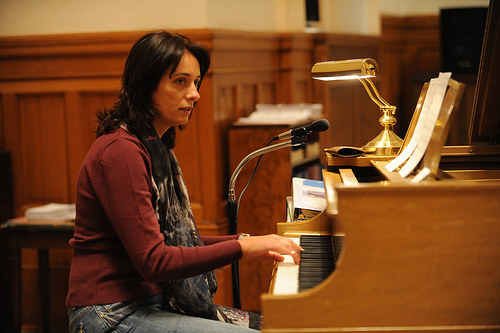
During the preparation of the gifts at Sunday Mass at St. Andrew, our music director, Dovile, came down from the choir loft to take Hala by the hand. Like sisters, they walked, hand in hand, to the piano upstairs. Hala, a school counselor in Nazareth, sat down and played a calming and peaceful melody, as her Jordanian and Palestinian colleagues in the front pews of our church sang a song in Arabic. They told us it translates into something like, “God, come to us. Make your home in us, in our hearts. Stay with us.”

Hala’s name means, “halo around the moon.” Because of her visit with us and the melody she played in our church and the song she left in our heart, the moon itself will now be more lovely in Milford.