Archive | Praying the Mass RSS feed for this section

We Remember Who We Are

15 Nov

On November 13, two weeks before we are to begin using the new words given to us in the Roman Missal, Deacon Tim Schutte spoke at all the Masses about reminders and being reminded, focussing on the four times in the Mass when we chant, “The Lord be with you … And with your spirit.” He said, “We are reminded four times that Jesus is fully present to us right now.” In that simple,  spiritual exchange, “we remember who we are, in relation to each other and to Christ.”

Listen to his words, as spoken at the 9:30 a.m. Mass, by clicking here: “The Lord be with you … And with your spirit.

Incarnate and Consubstantial: First Try

8 Nov

Many of the changes in the words that you will pray in two weeks will be chanted, that is, sung in simple tones of a couple notes that will keep repeating themselves. This will make the transition to the new words easier than if the words were just spoken. There is one place in the Mass that we – you and the priest together – will speak the Creed, the Profession of Faith. There are two words in particular that might sound real new to the ears, unless your ears are as old as mine, in which case the new words will sound familiar, as if they were stored in our memory and have come back to mind and have reached the lips: incarnate and consubstantial. Let’s take a first try at those two words. I say “first” try, because I am going to write something without going to any books, articles or dictionaries. After I write what I write and have it published here, I may need to clarify something or may want to try to say it differently.

incarnate

I was born. God was incarnate. God was not born like I was born. My parents were Roy and Isabelle. I was born on June 29, 1949. Before I was conceived in my mother’s womb, I did not exist. I came into existence when I was conceived in my mother’s womb. God always existed. God became man. God became flesh. Incarnate means “became flesh.” God did not just appear to be human. He was human. He did not just get inside a human body. He became a human being. Note, too, that God was “born” inBethlehem. God became “incarnate” inNazareth. The Incarnation took place inNazareth, when the angel appeared to Mary to tell her that she would conceive of the Holy Spirit, and, of course, when Mary agreed to accept God’s will.

consubstantial

This word is harder. My only comfort is that it took the Catholic Church a couple hundred years after the incarnation (see above) and the resurrection to come up with this word and to agree that this word was the best word that they could come up with to declare who Jesus Christ was and to explain the relationship between God the Father and God the Son. We can be humble enough to think that it might take us a couple tries to come up with the right words. For forty years we have said, “… one in being with the Father.” Now we will say, “… consubstantial with the Father.” It means that Jesus Christ is God, equal to God, the same as God.

consubstantial and incarnate

Jesus Christ is truly God and truly man. He is truly human and truly divine. He is God and man. He is human and divine. He is not either/or. He is both/and. These two words – consubstantial and incarnate – are the words that the Church has used over the centuries, and which we will use again anew on the First Sunday of Advent, November 27. Those words put us in touch with a long line of believers, and give us the assurance that we stand in line with what the Catholic Church believes, teaches and proclaims to be revealed by God.

As I go now to the stack of books and articles in which the experts give commentary on the new English translation of the Roman Missal, I simply say to you, “As your parish priest I love praying with you, as we pray the prayer and the prayers that the Roman Catholic Church gives us to pray at Mass.”

Speaking and Bowing: Oops!

30 Oct

This morning, as the kind young woman next to me in the pew – refer to the previous post – was helping me through Mass, at one point there was an “awkward” moment.

It has taken some time for us to get used to making that bow during the Profession of Faith, hasn’t it? Well, in the new English translation of the Creed, there are some words that are different at the time of that bow.

In the “new” Creed – it is actually the same Creed, just a different English translation of the same Latin version – I did okay getting past “consubstantial with the Father,” but I hit a snag when we got to the “incarnate” phrase.  

This is how the new text reads … this is how you will see it: 

“… consubstantial with the Father.

For us men and for our salvation

he came down from heaven,

At the words that follow up to and including and became man, all bow.

and by the Holy Spirit was incarnate of the Virgin Mary,

and became man.”

The phrase, “and by the Holy Spirit was incarnate of the Virgin Mary,” by itself would have been enough of an adjustment. But my problem was not so much with the new words, but with having to bow, while at the same time speaking the new words. It was made especially awkward because the girl next to me was holding the card with the words on it. Try it.

For awhile, it will be awkward.   

“Thank you for your kindness”

30 Oct

At the end of 8:00 a.m. Mass, I thanked the young woman for her kindness to me. She was in the pew next to me this morning at the Franciscan Monastery of the Holy Land in Washington, D.C. Yes, I know that I probably should have been concelebrating with the priests, but sometimes it is helpful for a priest, and in this case it was helpful for me, to experience Mass from viewpoint of the congregation.

The Franciscans, for what reason I do not know, are further along in using the new English translation of the Mass. I must have looked lost when, not singing the Gloria, everyone starting speaking the words of the “new” Gloria. The young woman moved closer, and held between the two of us a card on which all the people’s parts were printed, with the “different” words in a heavier, bolder font. As I looked around, everyone seemed to know where to find that card, except me.

That young woman, in her kindness, helped me through the Mass. Two thoughts come to my mind.

It will be important, come November 27, for the people in the pews at St. Andrew to help each other through Mass, until we all settle in with the new translation. Expect others to help you. And make it your own intention to help others. Get yourself as ready as you can. And then look for ways and means to help those who are sitting near you, especially those who look as lost as I must have looked to the woman next to me this morning.

The other thought that came to mind was that you will be helping me, or whoever the priest happens to be at the altar. For some weeks now, I have been thinking about what Father Ken and I need to do, right now and on those first Sundays of Advent, to help the transition be as smooth as possible, in other words, to help you make the transition. But wait a minute. We’re all in this together, aren’t we? We’ll work together, each doing what each of us can do. It is a relief for me to realize that it is not totally up to me and Deacon Tim – and Dovile and the choir – to make this transition happen. The Mass belongs to all of us. This new translation is given to all of us. You’ll help me as much as I help you. You’ll help the choir as much as the choir helps you. Phew! That feels much better. The tension is leaving the back of my neck.

At the end of Mass, you might hear, either from that “lost but now found” person who sat next to you or from me in the sanctuary, “Thank you for your kindness.”

Awkward: yes. Complain: no

30 Oct


“That was awkward,” is okay. “I don’t like that,” is not okay.

That is my rule for myself until May 27, six months from November 27.

On the First Sunday of Advent, November 27, the new English translation of the Mass will be used for the first time. There will inevitably be awkward moments. It will be okay to note them. It might even be good to celebrate them. But it will not do much good to complain about them.

In the new translation some of the wording in the prayers, dialogues and responses will be slightly different from the wording that we Catholics, and we Catholic priests, have used for the last forty years, or for as long as you have been alive, if you are not yet forty years old. It will be okay to point out the awkwardness, to share the awkwardness with a smile and maybe even with a laugh. But complaining will not help us to make progress or to be prayerful.  

My new rule – a rule for myself – will be: “No Complaining for Six Months.” We priests, maybe more honestly I should say, this priest (I) can be quick to say what I like and what I don’t like about the new translation of a word or phrase that we will use. But I would do well just to pray, using the words that the Church gives us to pray, and not analyze, object or change any word that is in that brand new Roman Missal that arrived in the mail a couple weeks ago.

So, if another priest or a parishioner complains, I must listen, but I do not need to join in, further or add to the complaint.  Perhaps in six months I will look back and discover that what was awkward is no longer so, and what I did not like, I like. Even if not, what the Church has given me to pray as a priest at Mass, I will pray at Mass.

You may want to stay away from me on May 28, when my rule expires. But let us hope that on May 29 all will be well.  

You-Me and Me-You

12 Oct

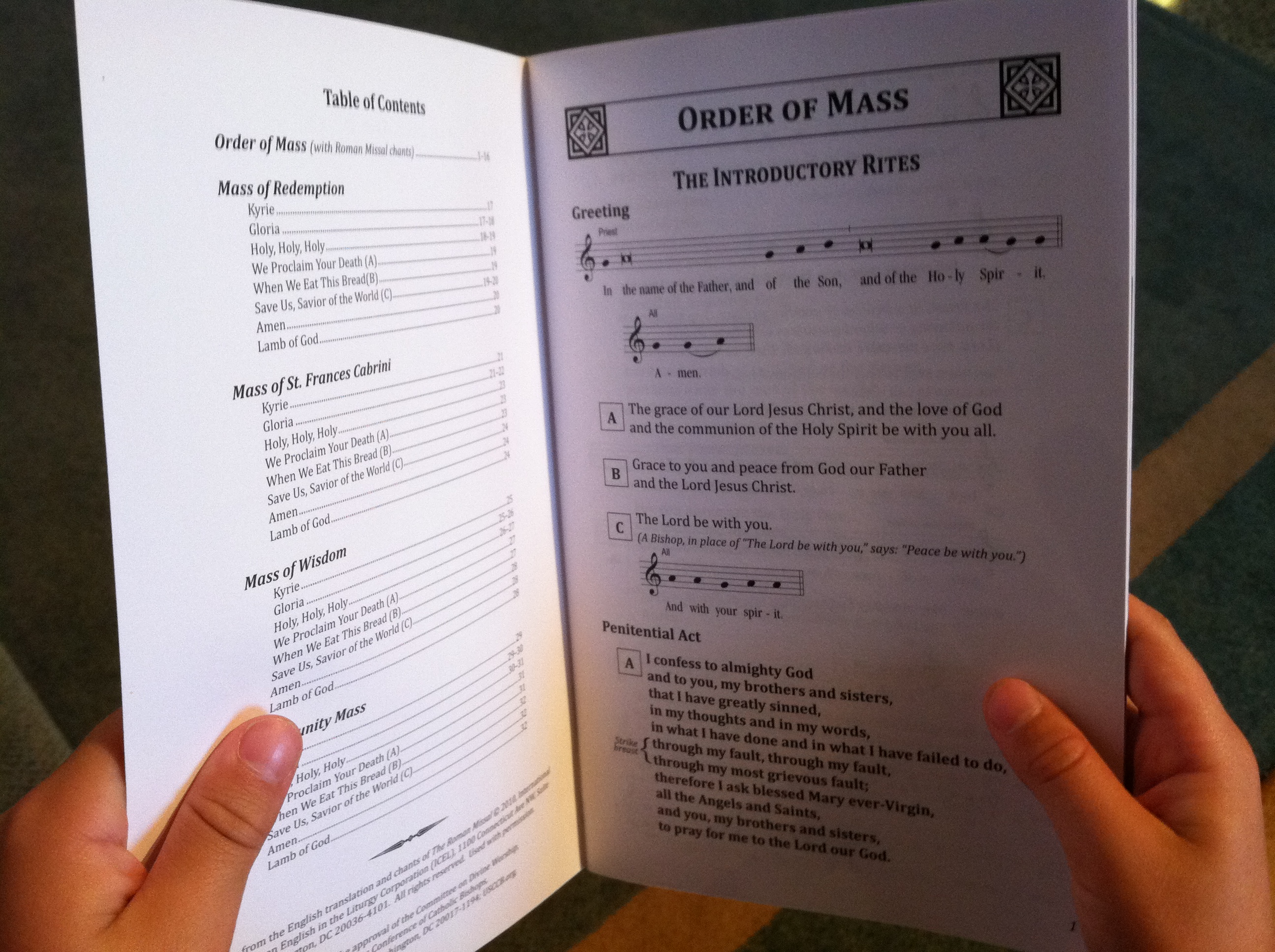
It was prepared by our local Worship Office, after extensive and comprehensive study and recommendations from Music Directors throughout the Archdiocese. You find it in the pew near you. The red booklet, “Revised Order of Mass with Additional Mass Settings,” will help us help each other. Notice that I say, “help each other.” I will help you, and you will help me. That is how we do things here at St. Andrew.

This weekend we begin singing the Holy, Holy, Holy (Sanctus) and the Memorial Acclamation (The Mystery of Faith) from the Revised Mass of Redemption. By the time we publicly and officially open the new Missal, we will be comfortable with the “new” words as sung in the Mass of Redemption.

During the homily at all the Masses on the weekend of November 13, Deacon Tim will introduce us to the new chants that will be sung every Sunday before and after the Gospel reading, and to the chanted dismissal at the end of Mass.

At all the Masses on the weekend of November 20, I will use the homily time to point out and to sing with you a “few of my favorite things” from the new Missal, which you will find in the red booklets. We will also bless the Missals for their first use on the next Sunday.


Andrew Got the Red Ribbon

12 Oct

The Roman Missal arrived just yesterday. Still in its packaging, it was begging for me to do something. What I decided to do was to let the school children open it

Today, at Mass with the 6th, 7th and 8th graders of our school, I volunteered the two students with a date of birth or a date of baptism closest to November 27 to open the package. For me the suspense was building, as I told them, “I haven’t seen it yet myself. The pages are going to be crisp. The binding and cover will be unblemished, no fingerprints or marks. The colored ribbons will be bright and ironed. The words will be fresh. The music is going to want to sing itself right off the page.” 

Standing on the sanctuary steps with their religion teachers and their music teacher, and with the music director and the deacon of St. Andrew parish, Kyle and Claire removed the outside plastic wrap. Inside the box they found the Missal covered with another coat of clear wrap. “Should we open it?” they asked. “Of course! It’s so big. Is it heavy?”   

The edges of the pages were gold. As they held it, they let me open it up to look inside. The book opened to the feast of the Annunciation. A full size picture was in color. The first letter of paragraphs of the prayers were capitalized and decorated. We found the feast of St. Elizabeth Ann Seton and put a ribbon at that place. St. Andrew, on November 30, got the red ribbon, being an Apostle.

The Church has given us a great big gift. Today at St. Andrew-St. Elizabeth Ann Seton we received the gift and opened it. Kyle took it into the sanctuary and opened it up on the altar. We are ready for Kyle’s birthday. I mean, we are getting ourselves ready – and are getting anxious – for the First Sunday of Advent to arrive.

The new English translation of the Roman Missal, Third Edition has arrived and is in our custody. We love it!  

Get Ready. Get Set. Praise!

29 Aug

God calls us, and we answer. We get ourselves ready by coming together and singing.  

We set ourselves in right position before God, noting our need for God’s mercy and God’s divine desire to save us.

And then, with a renewed appreciation of God’s greatness, raising our bowed heads, as if in a rush to praise God, we sing with excitement the song that the angels sang in Bethlehem on the night of Christ’s birth: “Glory to God in the highest, and on earth peace to people of good will.” We fall all over ourselves and one another, stumbling and fumbling and searching for adequate words, five times trying to find the right words to praise God, translating the original, melodic and dramatic Latin text – Laudámus te, benedícimus te, adorámus te, glorificámus te, grátias ágimus tibi propter magnam glóriam tuam – with our new English translation of praise: We praise you, we bless you, we adore you, we glorify you, we give you thanks for your great glory.

Our breath taken away in awe before God, and out of breath from praising, we sit down to allow the Spirit of God to fill us with new breath in the proclamation of the Scriptures. Sunday Mass has begun.

Here at St. Andrew our first step in welcoming the new English translation of the Roman Missal is becoming comfortable with singing the Gloria in a Mass setting composed by Steven R. Janco. Listen here to the Gloria from the Mass of Redemption.

Get ready. Get set. Praise!


Can You Come Out and Pray?

25 Aug


When I was a kid, in the days before cell phones, we got on our feet or on our bikes, and went in person to the home of our friends. Instead of ringing the doorbell, we stood outside and sang, without musical accompaniment, using just two notes, the higher note only for the name of the person and for the last word before the question mark, “O Steve, can you come out and play?” I do not know why we did it that way. We just did.  And it worked. If the kid didn’t come out himself, his mother appeared at the door, and told us why he was not coming out to play.  

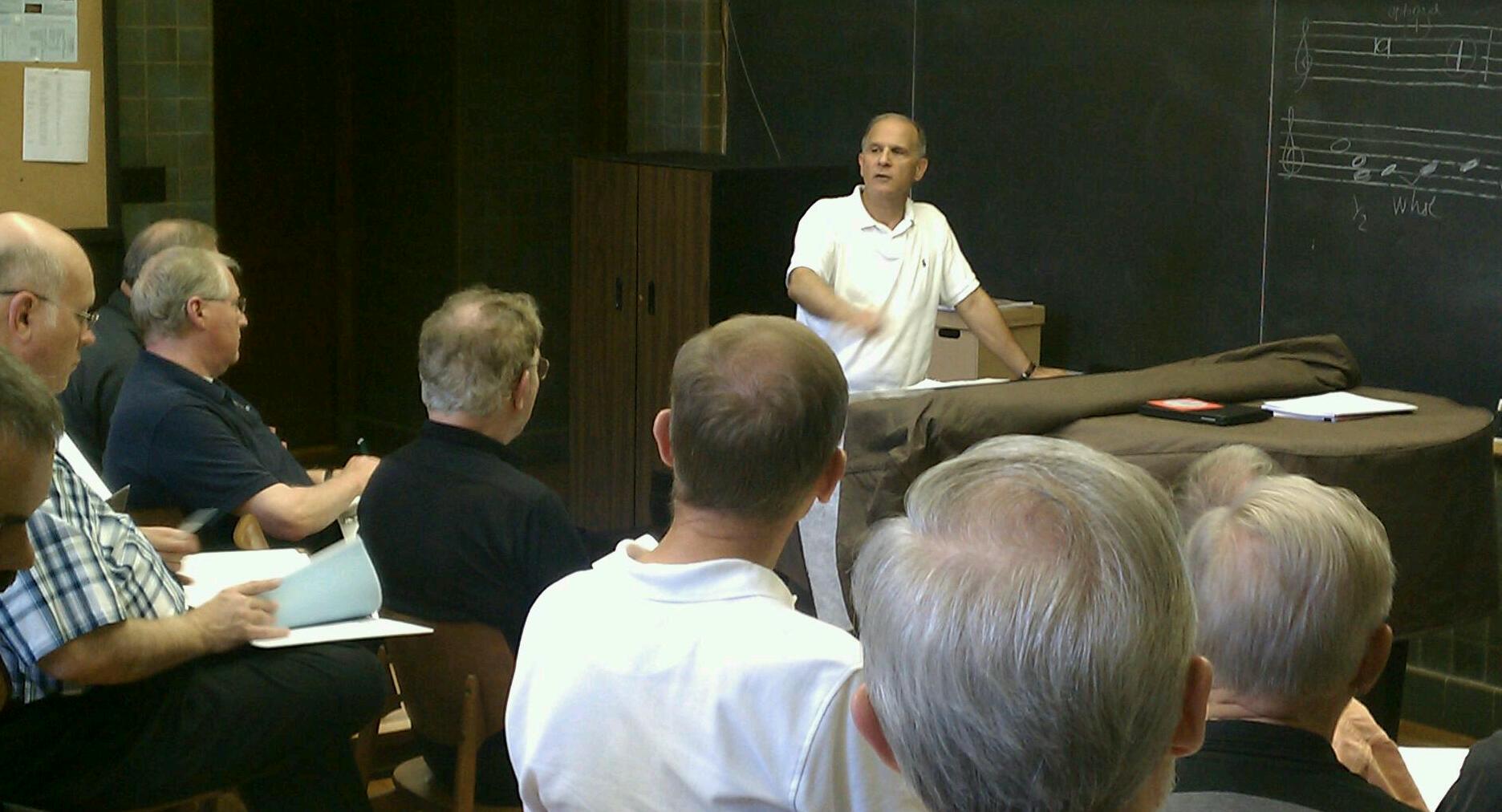
That distraction came to me when I was at a chant workshop for priests. We were learning the chants of the Roman Missal. When we begin to use the new English translation of the Mass on the First Sunday of Advent, we will be singing more than we have been. The new Missal, we are told, will have music printed all through the text. The music will not be tucked away in the back of the book in an appendix, as if singing were an afterthought or is an option. It is the Church’s way of saying, “Sing.” So, we priests have begun to learn how to chant the prayers and the dialogues of the Mass.

Chanting is singing a single line of music, that is, without any harmony line being sung at the same time by someone else, just one single line of music. It is usually just two, three or four notes repeated in rather predictable patterns. It is usually without any musical accompaniment. All that is heard is the human voice. It is simple and straightforward, not complex. Yet when a dialogue or a prayer is chanted, not just spoken, the words are raised to a new level and reach a deeper place in us. Listen to this prayer from Epiphany Sunday as it is chanted: Prayer over the Offerings.  

Here at St. Andrew, come November 27, we will begin slowly and gently, for the sake of the priests and the people. We will begin with the dialogues, those places in the Mass when the priest and the people are responding back and forth. Maybe the priest will also chant the prayers at the beginning and at the end of Mass, the ones he prays at his chair by himself, as the server holds “the big red book” (the Missal) for him.

So, soon we will have not only some new words, but also more singing, oops, I mean, chanting. It will be simple. And it will help us raise our minds and hearts to God, as we fall in love with the Mass all over again.  

I ♥ the Roman Missal

19 Aug

For a dozen months a priest friend and I have greeted each other, “I love the Roman Missal,” emphasizing the word “love” with a tone of voice that puzzled those who overheard us. “Are they being serious or sarcastic?” people wondered. With this playful exchange, I have been helped to make my way through some of my initial resistance to the changes in the Mass prayers that are coming soon. Yesterday my friend called me, using my cell phone number and finding me in Costco, as he knew he would, since it was a Thursday, “Do you know what tomorrow (meaning Friday, August 19) is?” When I admitted defeat, after making a couple guesses, he announced, “100 days until the new Roman Missal.” Of course, my response was, “I love the Roman Missal.”

The English words that we use at Mass today are the same ones I have used since I celebrated my first Mass in 1975. Now I must learn to pray anew, with new words. And you know what? That might be exactly what I need right now, after 36 years of hearing and speaking the same words at Mass.  

Those of us in the parishes have not replaced our weary and worn Mass books, because were told, again and again and again, for years, that a new English translation of the Mass was on its way. We kept asking, “When?” Now we know: in 100 days!

I ♥ the Roman Missal.