Archive | Holy Land Outreach to Palestinian Educators RSS feed for this section

“It was kind of you to share in my distress”

1 Dec

A people without hope perish.

A program called HOPE – Holy Land Outreach to Palestinian Educators – brought Christians teachers together. They teach in Catholic schools, in Cincinnati and in the Holy Land. What they have in common is that they teach children – and they teach with hope.

During the visit of our friends from the West Bank, Israel and Jordan, we prayed in many places and at many times.

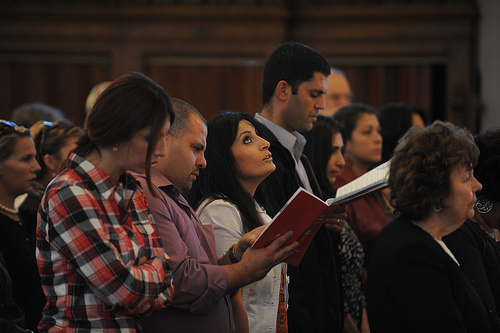
We prayed on a Sunday with the people of St. Andrew parish, Milford …

We prayed on a school day with the children of St. Lawrence school, Price Hill …

We prayed with the Sisters of Charity at their motherhouse, Delhi …

Having heard the personal stories of our Jordanian and Palestinian friends, and having shared in their struggles and sufferings as teachers, parents, citizens and believers living as a minority in their lands, we celebrated a last Mass together before they left toward home. Be in awe – and be filled with hope – as you read what was proclaimed at that Mass from St. Paul’s Letter to the Philippians, noting that the reading was not specifically chosen for the occasion but “just happened” to be the reading permanently assigned to that day in the Church’s established calendar of readings:

“Brothers and sisters:  I know how to live in humble circumstances; I know also how to live with abundance. In every circumstance and in all things I have learned the secret of  being well fed and of going hungry, of living in abundance and of being in  need. I can do all things in him who strengthens me. Still, it was kind of you to share in my distress. My God will fully supply  whatever you need, in accord with his glorious riches in Christ Jesus. To our  God and Father, glory forever and ever. Amen.”

We got what it takes!

1 Dec

What does it take to begin a partnership between St. Andrew-St. Elizabeth Ann Seton School in Milford and the Latin Patriarchate School in Beit Jala?

passion for learning

love of children

hope and gratitude

desire and longing

talent and faith

… and …

SASEAS principal, Tom

Beit Jala teacher, Eman          Beit Jala teacher, Waseim

… and …

the “techies” – Waseim (LPSBJ) … George (SASEAS) 

… and …

the “teachers” – Sue (America) … Eman (Palestine)

What does it take to build and continue a partnership between our SASEAS and their LPSBJ?

passion for learning

love of children

hope and gratitude

desire and longing

talent and faith

Eman … Tom … Waseim … George … Sue

We got what it takes!

“Keep my spirit, until I come back”

29 Nov

At the farewell dinner the night before the Christian teachers from the Holy Land left us to fly back home, Rogeece, in the name of the group, presented me with a piece of olive wood in the shape of a heart. This is how she explained the gift: 

When we were at the Freedom Center, I watched a six-to-seven minute video about a young boy who was from a slave family. He was escaping, in order to look for freedom, and then return to his family. His hope was to bring back freedom for all of them. When the young boy was about to say goodbye to his mother and his young sister, he gave them a heart-shaped stone. Handing his heart to his sister, he said, “Keep my spirit, until I come back.” He meant to come back as a human being, with all his rights and dignity, to give freedom to all of them.

As we leave Cincinnati, we give a heart-shaped piece of olive wood to you, our father, and to our sisters and brothers that we leave behind. We ask you to keep our spirit, until we get peace in our land, the Holy Land, until we live with our families in peaceful and just conditions, and until we return with dignity.

I will keep your heart close to my heart, Rogeece. I will keep your spirit, until you come back.

Peace the Angels Sang About

23 Nov

In the fields near Bethlehem … “Suddenly there was a multitude of the heavenly host with the angel, praising God and saying: Glory to God in the highest and on earth peace to those on whom his favor rests.”

Bethlehem is still not enjoying the peace that the angels sang about on that first Christmas night.

When we sing the Gloria at Mass, we begin, “Glory to God in the highest, and on earth peace to people of good will.” We sing the hymn of the angels at Christmas.

Eman, a teacher in the Catholic school in Beit Jala near Bethlehem, was at St. Andrew a few weeks ago, with other teachers from Catholic schools throughout the Holy Land. Coming from the West Bank, from Jordan and from Israel, the teachers spent time with teachers from our school, learning together and establishing a partnership for continued learning together.

At Sunday Mass as we sang the Gloria, we noticed Eman looking up.

A teacher from Bethlehem looking up as the hymn of the angels is sung. Was she hearing the angels? Was she expecting to hear them? Was she thinking of the angels and their peace song? Was she thinking of her students in Bethlehem who long for the peace about which angels sing?

We did not ask. We thought it best to leave it between her, the angels and the Prince of Peace born in Bethlehem.

آمين‎ and Amen

23 Oct

The message was one of HOPE. The prayer was for PEACE.

This time the children of our Catholic school at St. Andrew-Saint Elizabeth Ann Seton prayed the rosary not just “for” our sisters and brothers in the Holy Land. They prayed “with” their brothers and sisters of the Holy Land, during the visit of four Palestinian teachers from the Holy Land.

Each decade of the rosary on the wall and in their hands was a different color. For each decade there was a different intention and reflection. 

The first mystery of the five decade rosary was the “Visit of the Magi.” The color was green. The symbol was hope. The language was English.

The second mystery was “Jesus Speaks with the Samaritan Woman.” Appropriately, it was prayed in Arabic by the teacher from Nablus, the site of Jacob’s well, from which the teacher and her students still drink. The symbol was peace and unity; the color was blue.

Back to English, the third mystery, “Jesus Cures the Centurion’s Servant,” with white being the color, carried with it a message of healing, light and understanding.

The teacher from Beit Jala (Bethlehem) led the fourth mystery, “Jesus Sends Out His Disciples,” with its symbol of the Holy Spirit and its color of red.

The children finished with the fifth mystery in English, “The Conversion of Paul.” The yellow beads of the decade brought with them thoughts of optimism and joy.

At the end of each Our Father, Hail Mary and Glory Be there was an Amen, heard in English and in Arabic. The sound of “Amen” in English is not much different from the sound of “Ameen” in Arabic. In the praying, the children realized that the teachers from the Holy Land were not much different from the teachers in their own classrooms. The visiting teachers probably saw in the faces and voices of our students the hopes and dreams of their own students back home in Nablus and Beit Jala.  

آمين and Amen.

Consider This Clermont: Palestinian Educators

23 Oct

Thank you, Theresa, Kellie and John!

Our local “Milford-Miami Advertiser” reported twice, with photos, on the visit of the Palestinian Educators to Milford. Enough thanks cannot be given to Theresa Herron, editor, and to reporters Kellie Geist-May and John Seney. They and their Community Press could not have done more.  

photo: John Seney/The Community Press

Palestinian educators share experiences” by John Seney was published on October 13, with accompanying photos of the children and classrooms of the St. Andrew campus of SASEAS school. Take a look and read by clicking on the title.

 photo: John Seney/The Community Press

Palestinian educators to partner with Milford, Cincinnati teachers” was published on September 23. Clicking on the headline will take you to Kellie Geist-May’s article.

photo: John Seney/The Community Press

If you want to express your appreciation, here are their email addresses: therron@communitypress.com
(Theresa Herron), kmay@communitypress.com (Kellie Geist-May) and jseney@communitypress.com
(John Seney).

Christians 750, Samaritans 700, Muslims 344,550

7 Oct

photo credit: Mark Bowen/HOPE

They begin their presentation about their Catholic school by saying that there are 650 students, including 61 Christians and 4 Samaritans. “What? There are Samaritans in your school? … and only 61 of the 650 children in your school are Christians? … and it’s a Catholic school?” They have our attention.

The two Palestinian educators, the principal and an English teacher to 1st and 6th graders, are from Nablus in the West Bank. Nablus is the home of Jacob’s well. Remember Jacob’s well, where Jesus asked the Samaritan woman for a drink? Miss Abeer and Miss Ruya, and the people of Nablus, still drink water from that well. And there are still Samaritans in their town, 700 of them, which is almost all of the Samaritans left in the whole world. In a total population of 346,000 that is not a big number, but neither is the number of Christians: 750. Christians and Samaritans are obviously in the minority among the majority, the people of the Muslim faith.

There are four priests in Nablus: Greek Orthodox, Greek Catholic, Roman Catholic and Anglican. The fact that there are four churches is an indication that once there were many Christians in Nablus.

Nablus is known in the West Bank for its sweets and its soap. The Catholic school at which Miss Abeer is the principal and at which Miss Ruya is a teacher is also well-known for the excellent education it provides for all the children, Catholic, Muslim and Samaritan, who come through its doors and into its classrooms, whether or not their families have the money to pay the tuition.

Along with an olive wood cross with images of the Stations of the Cross, Miss Abeer and Miss Ruya brought me a box locally made soap. The sweets will be waiting for me when I make a return visit to their homes, their school and their city of Nablus in Palestine.

photo credit: Mark Bowen/HOPE

Nothing as Sacred as Home

6 Oct

photo credit: Mark Bowen/HOPE

After our visit with Archbishop Dennis Schnurr and two of his office directors, Dr. Mike Gable (Missions) and Dr. Jim Rigg (Education), to thank the bishop and to receive his blessing, we went to the National Underground Railroad Freedom Center. It took visitors from 6,000 miles away to take me to a museum in my hometown. 

photo credit: Mark Bowen/HOPE

Sitting on a bench with real-life Palestinians “in the home” of a “slave,” as an actress, playing the part, welcomed us into her home for a rest from our journey and told us her story, I was wondering whether or not my guests were hearing their story in hers. Her advice to us was remarkably applicable to them, “You’re on a journey – and you’ll get there. You hold on to family! This is my home. This is my home. There is nothing in the whole world as sacred as home. It’s time for you to go home now.”

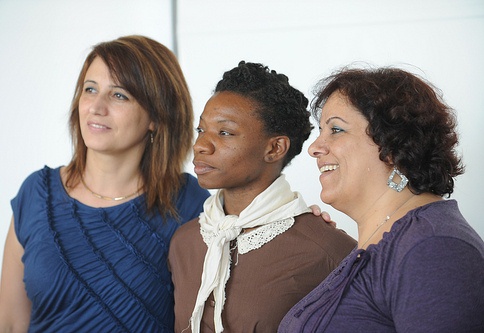
After the presentation, we snapped a photo of three women – the “slave” and two Palestinians, one from Nazareth carrying an Israeli passport and the other from the West Bank carrying a Palestinian passport. Three women, on a journey toward rights and freedom, holding on to family, with nothing as sacred as home – how alike they were!

photo credit: Mark Bowen/HOPE

Shokran … Afwan

5 Oct

photo credit: Mark Bowen/HOPE

A lot of Arabic was heard in our classrooms and hallways today at St. Andrew-St. Elizabeth Ann Seton School. “Marhaba (hello) … Shokran (thank you) … Afwan (you’re welcome),” were coming from all our K-8 students, punctuated with grins and hugs.

Our visitors were teachers from Catholic schools in Beit Jala and Nablus in the West Bank. Guided through our school by our principal, the Christian teachers glided into rooms of children, as if they were walking in on groups of their own students back home in Palestine.

The children were all eyes and ears, as they learned that, yes, in the Catholic schools in the Holy Land, children wear uniforms and play soccer, that they go to school on Saturday, but not on Friday and Sunday, and that many of their classmates are Muslims.

After being asked by Miss Abeer and Miss Ruya whether they knew the Bible story about the Good Samaritan, and about Jesus meeting a Samaritan woman at Jacob’s well and giving her a drink, the children seemed amused that people in Nablus still drink from the same Jacob’s well and that there are six Samaritan children in the Catholic school.   

The children were impressed when Miss Eman and Mr. Waseim told them that Beit Jala was right next to Bethlehem, and that they lived where Jesus was born. But they did not like hearing that the students in Beit Jala could not go on field trips because of a high wall that has been built around their town to keep them in. They were puzzled when they heard that, if the first Christmas took place today, Mary and Joseph wouldn’t be able to get into Bethlehem because 0f that high wall.

photo credit: Mark Bowen/HOPE

Halo Around the Moon

4 Oct

photo credit: Mark Bowen/HOPE

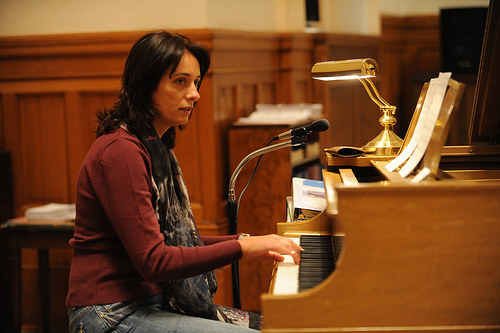
During the preparation of the gifts at Sunday Mass at St. Andrew, our music director, Dovile, came down from the choir loft to take Hala by the hand. Like sisters, they walked, hand in hand, to the piano upstairs. Hala, a school counselor in Nazareth, sat down and played a calming and peaceful melody, as her Jordanian and Palestinian colleagues in the front pews of our church sang a song in Arabic. They told us it translates into something like, “God, come to us. Make your home in us, in our hearts. Stay with us.”

Hala’s name means, “halo around the moon.” Because of her visit with us and the melody she played in our church and the song she left in our heart, the moon itself will now be more lovely in Milford.