
Tags: Beit Jala, Christians in the Holy Land, Cremisan, Cremisan Monastery, Cremisan Valley, Israeli-Palestinian conflict, Palestine, Palestinian Christians, Security Barrier, security wall, Separation Wall, USCCB
Postcards sometimes come in the mail with a message from our friends, “Wish you were here.”
I am hoping my friends in the town of Beit Jala, in the area of Bethlehem, in the West Bank of Palestine, will see this message, sent by me to them, “Wish I were there.”
I wish I were there.
I wish I were there with you in Cremisan Valley.
I wish I were there with you to prayerfully protest the taking of your land.

I wish I were there with you, as the Israeli government under the protection of the Israeli Defense Forces starts again to uproot your olive trees, to clear the way for the separation wall that they prepare to build on your land.

I wish I were there to genuflect with you and your priests before the altar, decorated with new olive trees in front of it and Israeli soldiers behind it; before the altar, on which rests that blue ceramic chalice that was the gift of our parish and our teachers to you, when we celebrated Mass with you in that same valley. 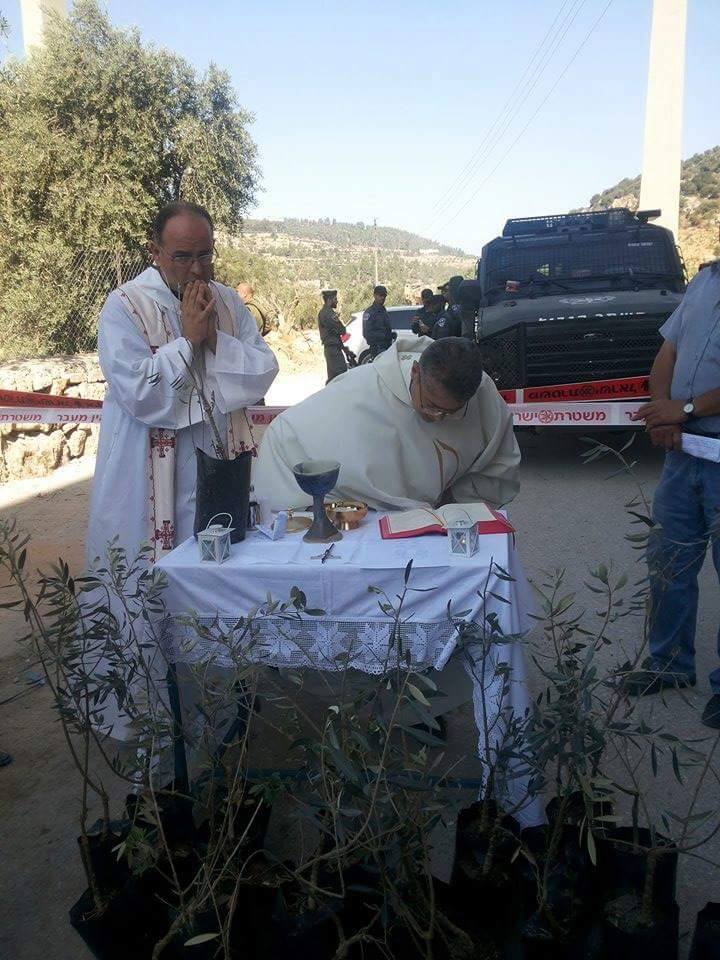
I wish I were there to stand beside your Catholic parish priest as he stands in front of – and stands up to – the Israeli soldiers.
 I wish I were there with you in Cremisan Valley.
I wish I were there.
(Unfamiliar with the news story of August 18, 2015: see Israel resumes work on controversial separation wall in Cremisan valley.)
What are the main messages of Laudato Si, Pope Francis’s groundbreaking new encyclical on the environment?
1. The spiritual perspective is now part of the discussion on the environment.
The greatest contribution of Laudato Si, to my mind, is an overview of the environmental crisis from a religious point of view. Until now, the dialogue about the environment has been framed mainly using political, scientific and economic language. Now, the language of faith enters the discussion — clearly, decisively and systematically.
2. The poor are disproportionately affected by climate change.
The disproportionate effect of environmental change on the poor is strongly highlighted in almost every page of the document, and the Pope provides many baneful examples of the effects of climate change, whose “worst impact” is felt by those in developing countries (25).
3. Less is more.
Pope Francis takes aim at the “technocratic” mindset, in which technology is seen as the key to human existence. He also critiques an unthinking reliance on market forces, in which every technological advancement is embraced before considering how it will affect our world. Christian spirituality, by contrast, offers a growth marked by “moderation and the capacity to be happy with little” (222).
4. Catholic social teaching now includes teaching on the environment.
Against those who argue that a papal encyclical on the environment has no real authority, Pope Francis explicitly states that Laudato Si “is now added to the body of the Church’s social teaching” (15). It continues the church’s reflection on modern-day problems that began with Leo XIII’s encyclical Rerum Novarum, on capital and labor, published in 1891.
5. Discussions about ecology can be grounded in the Bible and church tradition.
In Chapter Two, Pope Francis introduces “The Gospel of Creation,” in which he leads readers through the call to care for creation that extends as far back as the Book of Genesis, when humankind was called to “till and keep” the earth (67). But we have, sadly, done too much tilling and not enough keeping.
6. Everything is connected — including the economy.
Laudato Si is a “systematic” approach to the problem. First, the Pope links all human beings to creation: “We are part of nature, included in it, and thus in constant interaction with it” (139). But our decisions have an inevitable effect on the environment. A blind pursuit of money that sets aside the interests of the marginalized and the ruination of the planet are connected.
7. Scientific research on the environment is to be praised and used.
Pope Francis does not try to “prove” anything about climate change. Rather, his encyclical accepts the best scientific research available today and builds on it. So Laudato Si draws on both church teaching and contemporary scientific findings from other fields to help modern-day people reflect on a contemporary crisis.
8. Widespread indifference and selfishness worsen environmental problems.
Pope Francis strongly critiques those who ignore the problem of climate change, and especially its effects on the poor. Why are so many of the wealthy turning away from the poor? Not only because “some view themselves as more worthy than others,” but because frequently because decisions-makers are “far removed from the poor,” with no real contact to their brothers and sisters (90, 49). Selfishness also leads to the evaporation of the notion of the common good.
9. Global dialogue and solidarity are needed.
Perhaps more than any other encyclical, Laudato Si draws from the experiences of people around the world, referencing the findings of bishops’ conferences from Brazil, New Zealand, Southern Africa, Bolivia, Portugal, Germany, Argentina, the Dominican Republic, the Philippines, Australia and the United States. The pope invites into dialogue and debate “all people” about our “common home” (3).
10. A change of heart is required
This encyclical, addressed to “everyone living on this planet” calls for a new way of looking at things (3). We face an urgent crisis, when the earth has begun to look more and more like, in Francis’s vivid image, “an immense pile of filth” (21). Still, the document is hopeful, reminding us that because God is with us, all of us can strive to change course. We can move towards an “ecological conversion” in which we can listen to the “cry of the earth and the cry of the poor” (49). To use religious language, what the Pope is calling for is conversion.
James Martin, SJ, is a Jesuit priest, editor at large at America and author of Jesus: A Pilgrimage. This is an abridged version of an essay appearing today in America.
“So, Palestine got its first saints and recognition of statehood from the Vatican. But will this bring the Holy Land a step closer to peace?”
Pope will canonize two Palestinian nuns on Sunday. The canonization ceremony will come just days after the Holy See officially referred to Palestine as a state in a treaty.
 Sunday, May 17, Pope Francis canonizes four religious sisters.
Two of them are Palestinians:
Marie-Alphonsine, founder of Palestine’s first congregation, the Sisters of the Most Holy Rosary of Jerusalem, and
Mariam of Jesus Crucified Baouardy, the founder of Carmelite Convents in Bethlehem and India.
Speaking of the two Arab Palestinian women, His Beatitude Fouad Twal, Patriarch of the Latin Patriarchate Jerusalem, said, “Now, we have two new saints who represent a model of perfection for Christians, as well as for Muslims and Jews alike. They are both named Mary, and this name is widespread and commonly used among all three traditions. It is a sign of our modern time which suggests that we can talk about the three religions without any discrimination.”
Mother Mary, Marie-Alphonsine and Mariam of Jesus Crucified, all in heaven, pray for all who live in your native, mother land.

Appearing in the Cincinnati Enquirer, May 14, 2015:

Appearing in prayer the same morning:
O Lord, I am not worthy – or deserving. Nonetheless, and in spite of my faults and sins, you continue to heap acknowledgment on me. In your graciousness, please, please, continue to acknowledge my desire and efforts, and judged me on these. Please overlook my failures, clean up my mistakes, clear the debris I leave behind me, have mercy on me and grant me salvation, please, please, through Christ. I am sorry and I am grateful. Amen.
Even though the Holy See has referred to Palestine as a State over the past year, this marks the first official diplomatic communication to clearly refers to it as such.
DAY 1: Capernaum & Sea of Galilee
Where in your life does Jesus call you?
Day Two: Nazareth & Cana
Newly confident because we look at what has already happened, we are able to say, “Yes,” and something new comes out of that.
DAY 3: Sea of Galilee
Where do you get your one on one time with God?
DAY 4: Jordan River & Bethany
God stood in line with those waiting to baptized and went with his friends as they invited him to go “down there” with them.
DAY 5: Gethsemane & Holy Sepulchre
Surrender to the future that God has is store for you. Turn yourself over entirely to God, and God will reward you with new life.
DAY 6: Bethlehem
God entered the world in the most vulnerable way possible, completely dependent for his care – and also leaves the world in a vulnerable state, naked and nailed – a sign of his great desire to be with us. Even in inauthentic places there is authentic faith.
DAY 7: Jerusalem/Way of the Cross
We carry our cross in the midst of the busyness and hurriedness of daily life.
A homily in back to back Masses can be the same and different.
At the 8 o’clock Mass there was a baptism. I made a reference to (mother) Marni feeding her child.
At the 9:30 a.m. Mass there was dismissal of a catechumen (or candidate, I was not and still am not sure) after the homily. Then I got carried away introducing the universal prayer and forgot the creed. Rutro!
The homily was the same – and different. God is good.
 With Open Doors