Tag Archives: Beit Jala

we help to carry it as Simon of Cyrene did

29 Mar

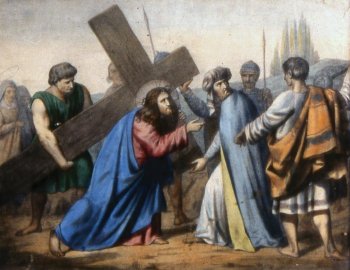
Station 5 Way of Cross Pope Francis 2013Way of the Cross at the Coliseum, Stations of the Cross led by the Holy Father, Pope Francis, on Good Friday: The Passion of the Lord Meditations by Lebanese young people under the guidance of His Eminent Beatitude Cardinal Béchara Boutros Raï.

[Whenever I pray the 5th station, I think of our suffering brother and sister Palestinians in Beit Jala. I like to think that, in some small way that might help them to keep hope, we help them carry their cross.]

V Station: Simon of Cyrene helps Jesus to carry the Cross

A Reading from the Holy Gospel according to Luke 23:26

As they led him away, they seized one Simon of Cyrene, who was coming in from the country, and laid on him the Cross, to carry it behind Jesus.

Jesus’ meeting with Simon of Cyrene took place in silence, providing us with a lesson for our lives: God does not want suffering and he does not accept evil. The same is true of the human being. But suffering, accepted in faith, is transformed into a path of salvation. Then we accept it as Jesus did, and we help to carry it as Simon of Cyrene did.

Lord Jesus,
you have involved man in the carrying of your Cross.
You have invited us to share your sufferings.
Simon of Cyrene is like us
and he teaches us to accept the Cross
that we encounter on the paths of life.

Following your example, Lord,
we too carry the Cross
of suffering and illness today,
but we accept it because you are with us.
It can nail us to our chair,
but it cannot prevent us from dreaming;
it can obscure our vision,
but it cannot touch our conscience;
it can deafen our ears,
but it cannot prevent us from listening;
it can bind our tongue
but it cannot suppress our thirst for truth;
it can weigh down our spirit,
but it cannot rob us of our freedom.

Lord,
we want to be your disciples
so as to carry your Cross every day;
we will carry it with joy and hope
because you are carrying it with us,
because you have triumphed over death for us.

We give you thanks, Lord,
for every sick or ailing person
who knows how to bear witness to your love,
and for every “Simon of Cyrene”
whom you place on our journey.
Amen.

ended with no decision by the court

15 Feb

St. Yves Society bannerOn Tuesday, 12th of February 2013, the final hearing for the case of the Cremisan Valley against the Separation Wall was held in front of the Special Appeals Committee in the Magistrate Court in Tel Aviv.

Our friend, Father Ibrahim Shomali, the Parish Priest of Beit Jala, was in the crowded courtroom to observe the proceedings. The Catholic auxiliary bishop of Jerusalem was also present.

A summary of the testimony  of both sides is provided by the Society of St. Yves Catholic Center for Human Rights. Obviously, the summary is of a tone that favors the case as presented by the side opposing the building of the wall.

The session ended with no decision by the court. It will be issued after the committee reviews the documents of the case that has gone on for seven years.St. Yves Society hearing photo

8:30 am Milford – and – 3:30 pm Beit Jala

8 Feb

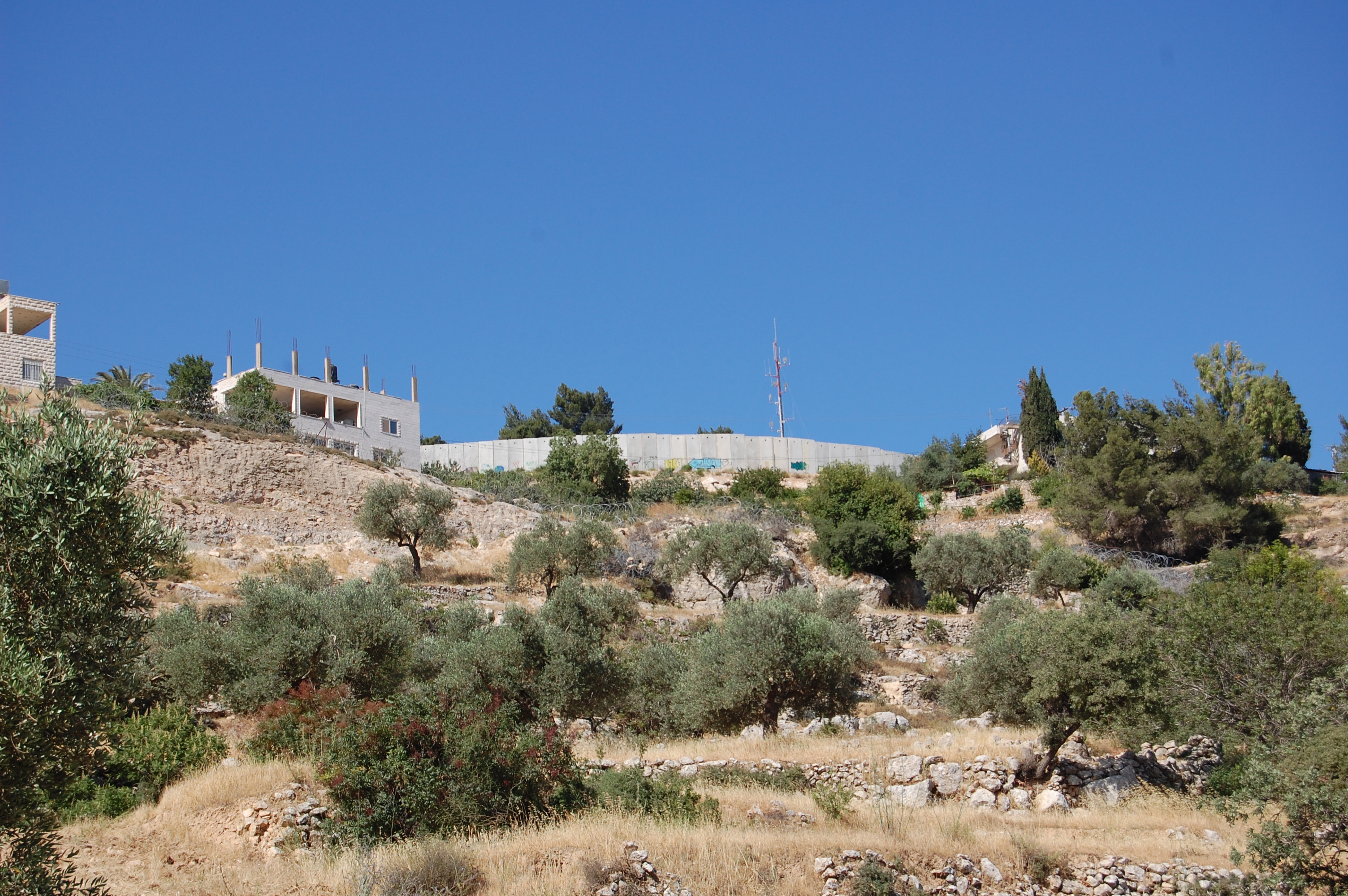
Mass has been celebrated in Cremisan valley every Friday afternoon at 3:30 p.m. in a prayer-protest of a proposed new section of what is called a separation wall by the Palestinians and a security fence by the Israelis. Whether it is for separation or security, it is definitely a wall, and not a fence, in this section of the structure that divides Beit Jala and Jerusalem.

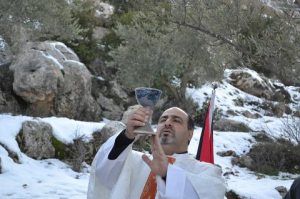
Earlier in January Father Ibrahim Shomali, the pastor of Annunciation Catholic Church in Beit Jala, celebrated the Mass in the cold and snow, after an unusual snowfall a couple days before.fr_ibraheem 2

We see on the altar a blue-green pottery chalice. Father Shomali has used this chalice for the weekly Mass ever since June.

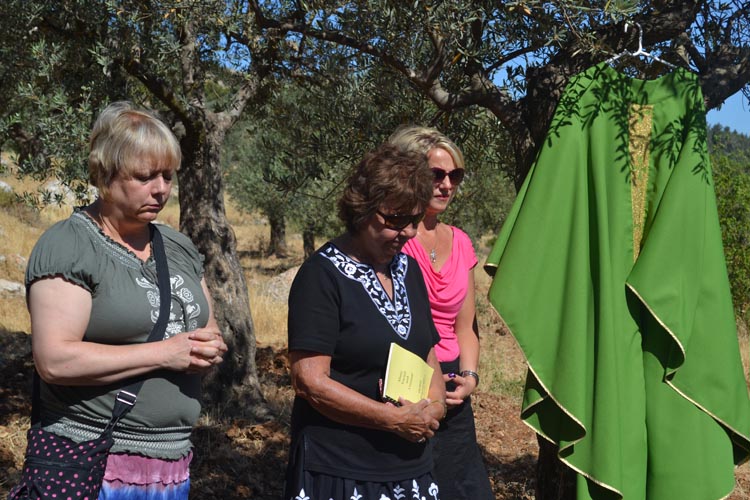
We brought it from Cincinnati as a gift to him and the parish. So, after we used it when we celebrated Mass in that olive grove in Cremisan valley on the edge of the town of Beit Jala in the Bethlehem-area, we left it behind, so that they might remember us in prayer as we remember them in prayer. ibrahin snow bend over 7

Today – Friday, February 8 – will be the last day that Father Shomali will celebrate Mass in that olive grove before the final decision of the Israeli government.  A final decision of the Israeli Court will be handed down on February 12. Will Israel take control of the Cremisan valley? Or will the Cremisan valley remain in the hands of the Palestinians?

PRAY. At 8:30 a.m.(Milford time) pray in solidarity with Father Ibrahim and the people of Beit Jala as they celebrate Mass at 3:30 p.m. (Beit Jala time).

ACT. As urged by the United States Conference of Catholic Bishops, sign the petition that will be taken to Israeli authorities in protest of the proposed building of this section of the wall.

8 days since I added my signature

7 Feb

save the valley in Cremisan: online petition

31 Jan

Cremisan school

The Society of St. Yves is the Catholic Center for Human Rights of the Latin Patriarchate (the Roman Catholic Archdiocese) in the Holy Land. The lawyers of this society have been arguing before the Israeli Supreme Court, at the request of the Latin Patriarchate, asking the Court to stop the Israeli government from building a new section of the security fence (separation wall) through the Cremisan valley at the edge of Beit Jala (Bethlehem).

Crem 97 Cremisan ohio_2012m

Last summer I celebrated Mass in Cremisan valley, and wrote about the place in this previous post: “Not on Friday, but on Tuesday.”

The Society of St. Yves outlines the reasons against the building of this section of the wall, and provides an online petition of support for their position that will be sent to Israeli authorities.  Find out more and sign the petition at “Save the valley in Cremisan: Support bridges, not walls!

When I signed the petition, I wrote this as my reason for signing:

Our friends in Israel could clearly express their desire for reconciliation and security for all who live in the land by a decision NOT to build this section of the fence/wall in the Cremisan valley as it is proposed. Just think of the good public relations message that the Israeli government would put out and the good will that they would spread by making it known that they want the Christians to stay, that they want the people of Beit Jala to have a green space in which to rest and play, that they want the people of the area to have access to water, that they do not want the farmers to lose their livelihood, and that they want the children of the valley to feel safe and secure enough to live and learn as all children deserve – by making it known that they will NOT build that proposed wall/fence through the valley of Cremisan. The Israelis and the Israel government have an opportunity here that they do not often have to put their actions where their words are and their hearts where their minds are. An international audience would hear the message. Not building the wall/fence in the Cremisan Valley along the proposed route is a win-win situation for both the Israelis and the Palestinians, and especially for the children on both sides of that fence/wall that now divides them.

Crem 90 Cremisan jen holy land 964 (205)

You are most welcome

31 Dec

While on pilgrimage in the Holy Land in June 2012 with a group of teachers from various schools in our Archdiocese of Cincinnati we celebrated an outdoor Mass in Cremisan Valley in an olive grove. It was then that we met Deacon Sleiman (Solomon), a student at the Latin Patriarchate Seminary who is serving as deacon at Annunciation Church in Beit Jala.

In his car Deacon Solomon led our bus on its way through the village of Beit Jala, up over the hill and around the winding roads, to the Cremisan Valley. In the open trunk of his car, he brought along an altar table, and inside the car he had everything we needed for Mass. He was the perfect host and gentleman. He is, in the words of one of our pilgrim-teachers, a holy man – and he will be a good and holy priest.

As you see him and hear him in this YouTube video, enjoy his smile and his obvious love for the Church. We can assure  y0u that he means it when he says, “You are most welcome to be here with us in our Annunication Church in Beit Jala.”

not on Friday, but on Tuesday

15 Nov

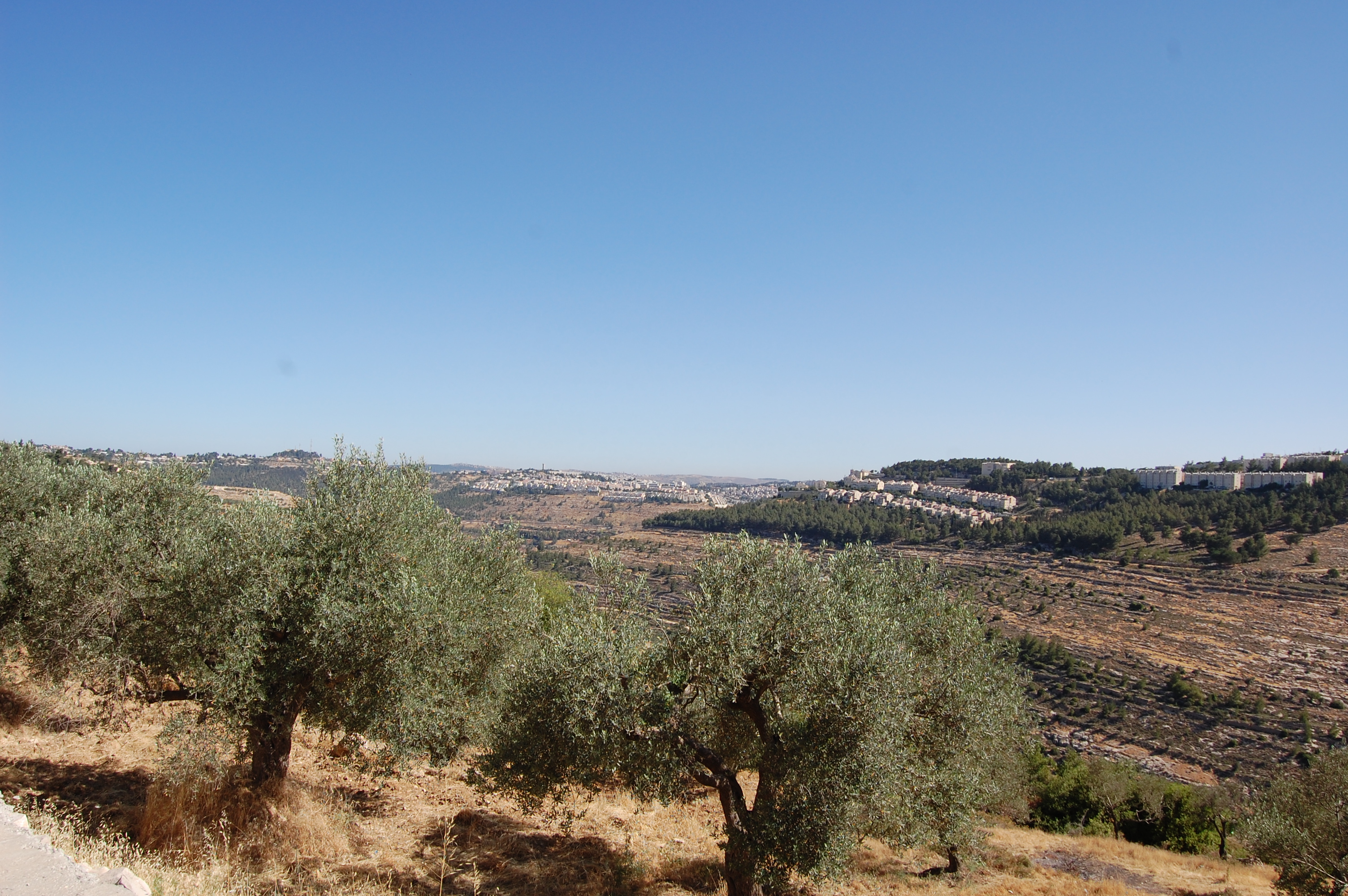
Every Friday afternoon at 3:00 p.m., with obvious connections to the time of suffering that Jesus endured on the Friday that we call Good, Father Ibrahim Shomali, the parish priest of Beit Jala (Bethlehem) celebrates the Holy Sacrifice of the Mass with his people in an olive grove in Cremisan Valley on the outskirts of the town.

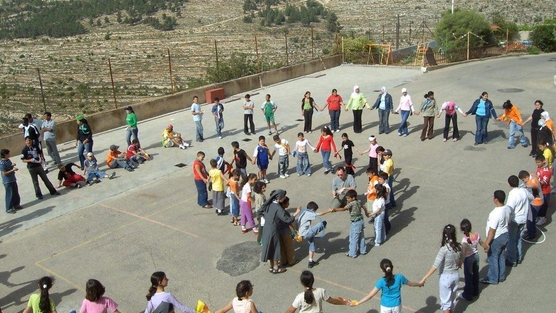
This place is chosen by the parish of Beit Jala for Mass to protest in a prayerful and nonviolent way the proposed path that the Israeli government plans to follow in building another section of the separation wall through this very valley. What the Palestinians (and I) and many Israeli citizens call a separation wall, some proponents prefer to call a security fence, claiming that only 3% of it is actually a wall, and that the rest is a low lying, barbed wire structure. There is no doubt that this section will not be a fence; it will be a wall. And it will separate: 58 families  from their olive groves, 450 children from their school at the convent of the Silesian sisters, and all the people of Beit Jala from the only recreational park, green space that is left for them. And it is hard to imagine how this particular re-routing of the wall to take more land and water for Israel is necessary for security.

The schedule for our pilgrim-teachers from schools of our Archdiocese of Cincinnati did not allow us to join him/them on Friday, so Father Ibrahim arranged for Deacon Suleiman to accompany us to the place for Mass on a Tuesday morning.

When we arrived, we found the ground turned up and over. Someone had obviously plowed the ground.

It was alleged by some of the locals that the Israeli government had done that to make it difficult to pray there. No matter who did it or why it was done, the turned up ground did make it quite complicated to walk and difficult to stand, the slightest shift of our weight causing our feet to slip from underneath us. The situation made us more determined in our prayer. We stood our ground as best as we could.

Deacon Suleiman called us to worship with a reminder that Jesus prayed on the night before his crucifixion in another grove of olive trees: at the base of the Mount of Olives in Jerusalem. These olives trees are a Gethsemane of another kind. Here the agony of the garden continues.

We prayed that the agony of our friends from Beit Jala will be eased.

As we left, some of us picked up stones and olive branches, not knowing whether or not we will ever be able to return with them to this place.

“Based on our years as parish priests in Palestine”

23 Apr

Good Friday Procession in Jerusalem (Photo: Travelujah)

Father Faysal Hijazeen is the parish priest of the Ramallah’s Holy Family Church and head of Latin Patriarchate Schools in Palestine. Father Ibrahim Shomali is parish priest of the Annunciation Church in Beit Jala.

Together they wrote an op-ed piece that is published in the online Jerusalem Post on 04/16/2012: “The plight of Palestinian Christians.”

Fathers Hijazeen and Ibrahim began by saying that they “were appalled by the false allegations regarding Palestinian Christians made in recent weeks by Israeli spokespeople, such as (Israeli) Ambassador (to the U.S.) Michael Oren.”

They make it quite clear that they think that “the end of the Israeli occupation would allow all our people, Christians and Muslims, to develop all our potential living side by side.”

It is not persecution by the Muslims but the (Israeli) occupation itself that is at the root of the problem of the dwindling numbers of Christians in the Holy Land. “The Israeli occupation and settlement activities are the main reason for Christian emigration.” 

“Kairos Palestine” Document

22 Apr

For the sake of my fellow pilgrim-teachers here is a link to The Kairos Palestine Document – A moment of truth: A word of faith, hope and love from the heart of Palestinian suffering.

My Watch is “Two-Faced”

10 Apr

Usually I wear a wristwatch that has two “faces.” One is set for local, Milford, time – 10:47 a.m. in the photo below. The other is seven hours ahead: 5:47 p.m., which is “Bethlehem time.” I keep myself on track … and I am constantly reminded of my friends in Bethlehem, Beit Jala, Beit Sahour, Nablus, Nazareth and Jerusalem.

Sunday morning as I reached into my dresser drawer for a clean handkerchief, I noticed my “good” watch. I wear it on special occasions. Easter is special! So, onto my wrist went my good watch. As a reminder that Easter Day is actually an Octave, I will wear my special watch for eight days, until next Sunday evening.I can easily and quickly add seven hours to remember whether my friends in the Holy Land are awake or asleep.