This is the question that I asked on Easter Sunday: “Is the candle tall enough?
This is the question that I ask on Easter Monday: “Is my hope tall enough?”

This is the question that I asked on Easter Sunday: “Is the candle tall enough?
This is the question that I ask on Easter Monday: “Is my hope tall enough?”

On Good Friday the wall behind our altar is noticeably blank. Something is missing. If one looks closely, one sees where the crucifix usually is. It is taken down to be carried in procession into church for the Veneration of the Cross during the Liturgy of Lord’s Passion.

Jesus knows suffering: physical suffering, emotional suffering, and spiritual suffering. He knew the pain of whips, thorns and nails. He knew the pain of betrayal and the pain of being left alone in agony. He knew the pain of feeling abandoned by God. He knows suffering.
When we go to him because we are suffering, physically, emotionally or spiritually, we know that he understands. He gets it!
Here’s how I tried to say that on Good Friday:
During the veneration of the cross our music director played a piece for the first here at St. Andrew, which was the first time ever that the piece was played and sung anywhere. The “Ave Maria – Woman of Sorrow” was written/composed by our Deacon, Timothy S. Schutte, at the death of Pope John Paul II. Good Friday is the one day of the year that the text and music is appropriate; it is meant for Good Friday. The piece joins the Annunciation and the Crucifixion, the conception of Jesus in her womb and the death of Jesus on his cross. As Mary stands at the foot of the cross in her overwhelming grief, she remembers and feels all over again her bewilderment when she was face to face with the angel Gabriel.
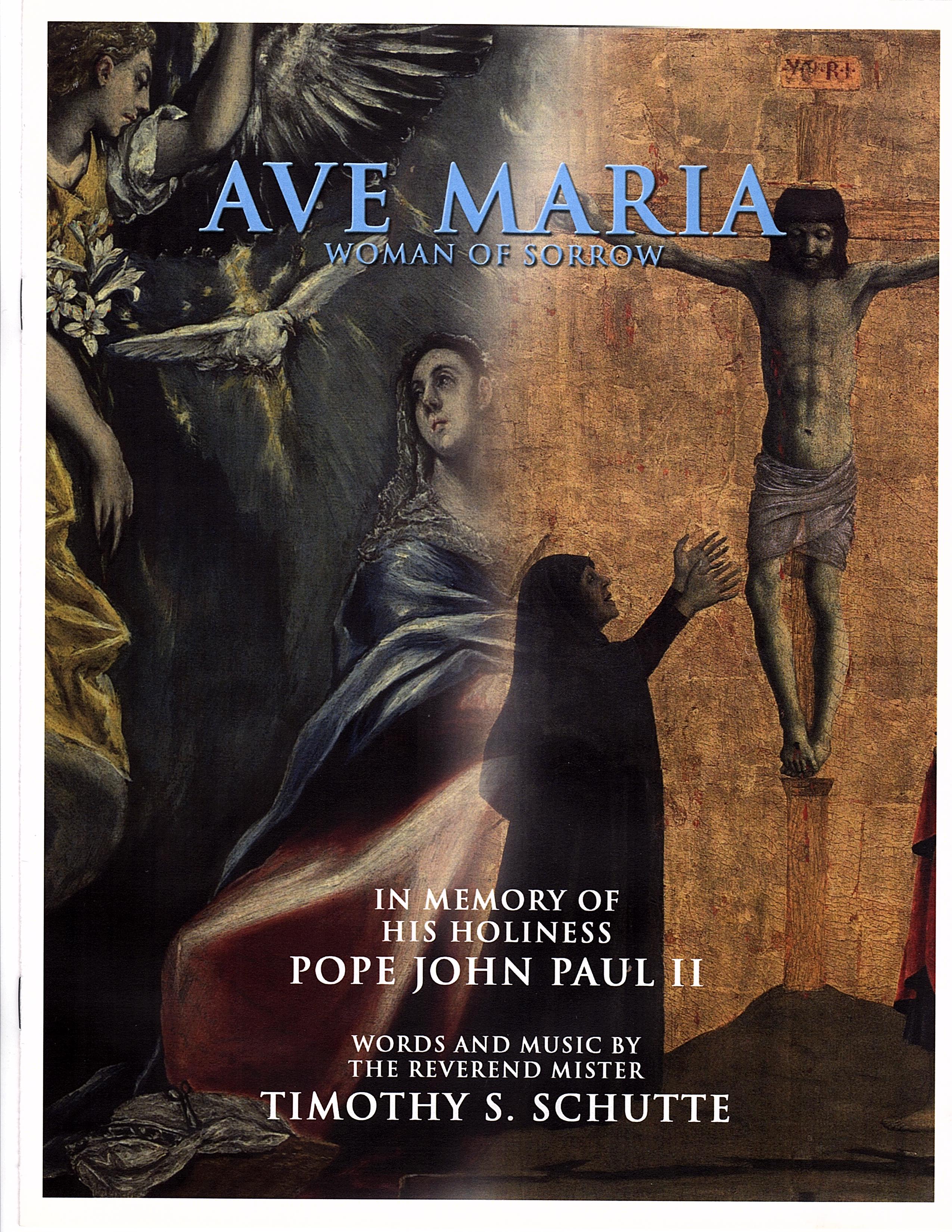
The refrain is the words of the angel to Mary, “Hail Mary, full of grace, the Lord is with you, and blessed are you” (in Latin). In the grief of Good Friday, Mary speaks, “My Heart pierced through, / my sorrow the sword. / His mission done, / my tears freely flow,” and then the line that connects this moment to her response to the angel, “Look what my ‘yes’ has done.” But then God speaks, “Oh fairest one, / do not despair / your Son and Mine, Divine Heir / His love poured out, / My face you see,” and ends with a phrase echoing back to Mary her own words, “Look what your ‘yes’ has done.”
Here’s how our choir sang it on Good Friday:
In the Chaplet of Divine Mercy, we pray, “Eternal Father, for the sake of his sorrowful passion, have mercy on us and on the whole world.”
This is the announcement that I made at the end of all the Masses at St. Andrew this past weekend. If YouTube ever cooperates with me, I will add at the end of this blog a video clip of the announcement. Until then, read the text and enjoy.

Fourteen years ago, when I first moved to Milford and into St. Andrew, it never dawned on me how fast the day would come, when I would stand before you to make this announcement.
If we were in the Vatican there would be white smoke coming out of the roof, and someone would step out on the balcony, and shout: “Annuntio vobis gaudium magnum. (I announce to you — A great joy.) Habemus Papam! (We have a Pope!) We would hear his given name and the name by which he chooses to be called.
We are not in the Vatican. Here’s hoping that there is not smoke of any color coming out of the church roof.
But I announce to you a great joy. We have a Pastor! It is the Reverend Father Anthony Cutcher, who chooses to be called Father Tony.
These are the biographical words that he has given to me to speak to you: “Fr. Tony Cutcher was ordained in 1999 by Archbishop Pilarczyk and has served as Parochial Vicar at St. Peter Parish, Huber Heights; Pastor of Sts. Peter and Paul Parish in Newport, OHIO and most recently as pastor of Holy Rosary Church in Saint Marys, OH. He is currently serving as President of the National Federation of Priests Councils, which is headquartered in Chicago. In his role, he travels extensively to speak with priests and bishops and facilitates better communications among the priests, bishops and councils. He is excited to be returning home and resuming pastoral duties.”
You have no idea who he is, do you? Remember that, fourteen years ago, you had no idea who I was either.
God has been very, very good to us. God will continue to be good to us.
Please pray for Father Tony is his transition – and for me in mine.
I will ask Father Tony to join me in praying for you in yours.

My stomach was messy. By the end of the day there would certainly be the expected and violent reaction of my innards. I’d better stay close to my bathroom.
Yesterday I was waiting for a call from the bishop.
Fourteen pastors are being appointed to take up new assignments this summer. Since I am retiring at the end of June, one of them is to be assigned here to St. Andrew. Someone else will live in the house that has been mine for fourteen years. Someone else will sit in the presider’s chair at church where I have sat during Mass all these years.
Why was my stomach messing with me? I am not the one being re-assigned. I have chosen to leave.
I was told to be accessible by phone from 12:30 p.m. until 5:30 p.m. The call would come from the bishop sometime within those five hours.
Getting testy and snippy with a couple people in our office, as I do when I am frustrated or when something is in my charge but out of my control, I went to church. Yes, taking my cell phone with me.
My ringtone, named “Bulletin” on my new iPhone, sounded. It was from “Chancery Archdiocese.” I did not have to ask whose voice that was on the other end.
The bishop gave me the name of the priest who will be coming to the parish, asked me not to tell the staff for several days, suggested that I make an announcement at all Masses this Sunday, and requested that I call the priest. Repeat: keep the name to myself for several days, in order to let all the people of the parish hear the message at about the very same time, hence the reason for waiting until Sunday Masses.
I really, really, really want to tell my staff who their new pastor (their new boss) will be. But I will follow the protocol given to me by the bishop.
My leaving is all the more real for me now, knowing the name of the priest who will have his future in Milford and at St. Andrew. Maybe that is why my stomach was messing with me. I am actually leaving. And I do not usually keep things from my staff that are significant to their work and their working relationships in the parish. Maybe that is why my stomach was messing with me.
A week from now this will not feel so big. But for now …
my stomach is messing with me.

 The Pontifical North American College is the school of theology to which bishops from throughout the United States send a seminarian or two for the four years of study and formation before being ordained a priest.

Lord, I am not worthy
that you should enter under my roof,
but only say the word
and my soul shall be healed.
This is what we say before receiving Holy Communion.
We find these words (sort of) in two of the four Gospels, with a couple details differing.
In Matthew 8:7-8, the centurion comes to Jesus himself, asking for a cure for his servant. When Jesus says, “I will come [to your house] and cure him,” the centurion responds, “Lord, I am not worthy to have you enter under my roof [the roof of my house]; only say the word and my servant will be healed.”
The words in Matthew are closer to what we say at Communion, but the words in Luke are closer to what we mean when we say them.
In Luke 7:5-7, the centurion, being a non-Jew, sends elders of the Jews, maybe thinking that they will have a better chance at getting Jesus’ ear, and asks them to ask Jesus to come [to his house] to cure his servant. The elders tell Jesus that the centurion “deserves to have you do this for him.” But when the centurion hears that Jesus is coming toward him and his house, he realizes that he does not deserve to have Jesus do this for him. He sends his friends, people who know him better, that is, to Jesus to tell him, “Lord, do not trouble yourself, for I am not worthy to have you enter under my roof [the roof of my house]. Therefore, I did not consider myself worthy to come to you; but say the word and let my servant be healed.”
Hmm. I do not deserve to have you do this for me. I do not consider myself worthy to come to you. I am not worthy to have you come to me. But say the word and I will be healed.
Lord, I am not worthy
that you should enter under my roof,
but only say the word
and my soul shall be healed.
I am not worthy to come under “his” roof: I am not worthy to walk into “his house,” to kneel in its pews and or to approach its altar.
I am not worthy to have him come under “my” roof: I am not worthy to have him in my house, where I live.
I am not worthy to receive him under the roof of my mouth in holy communion.
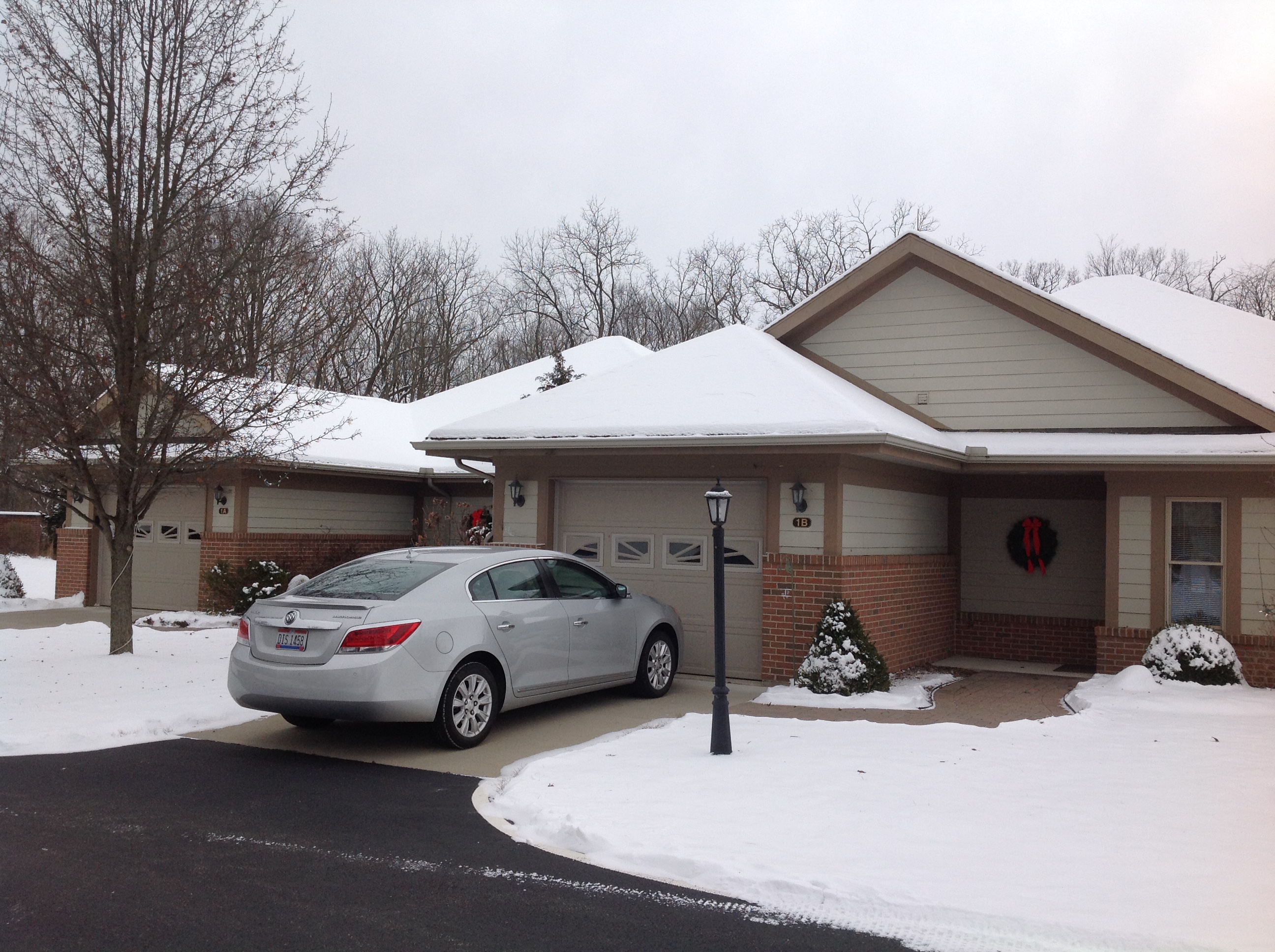
As I pulled into the driveway of my retirement home for the first time, I walked into the doors of my new place with a realization and a prayer:
Lord, I am not worthy
that you should enter under my roof,
but only say the word
and my soul shall be healed.





 With Open Doors