Sign the petition that supports bridges, not walls. Raise your voice for peace in the Holy Land ow.ly/hvnfG
— USCCB (@USCCB) February 7, 2013
Archive | Pilgrimage to the Holy Land RSS feed for this section
8 days since I added my signature
7 Feb(most) enjoyed and concerned
5 FebSomeone asked me what I most enjoyed recently about being Catholic – and – what concerned me most about the future of the Church. This is how I responded? How would you respond?

Most enjoyed being Catholic? Being in the Middle East at Catholic Mass and having pilgrims tell me how much they appreciated the ritual of the Catholic Church and how comfortable they felt at Sunday Mass when the vernacular was not their own language. Because of the ritual, they could tell where they were in Mass and what was happening and was being said, even though they understood not a word of Arabic. One even noted that the priest, speaking Arabic, had the same inflection and cadence in his voice that his priest back home used when celebrating Mass in English.
Most concerned about the future? That people and priests will become more and more imbedded in opposing camps, and will fail to take the humble stance and maintain the humble attitude to listen, to learn and to realize that the church does not belong to any of them. I fear that believers will feel so strongly about what they believe that they will always see things as simple and clear, that their first thought will be to try to control and convince the others, and that thus all conversation and growth will be stifled.
save the valley in Cremisan: online petition
31 Jan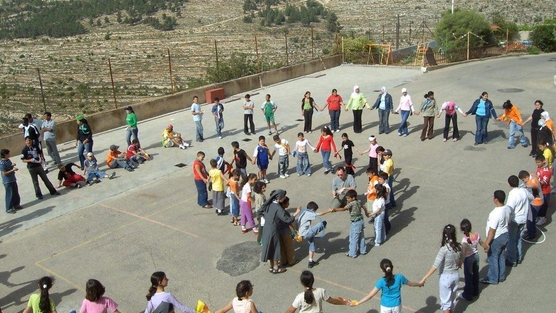
The Society of St. Yves is the Catholic Center for Human Rights of the Latin Patriarchate (the Roman Catholic Archdiocese) in the Holy Land. The lawyers of this society have been arguing before the Israeli Supreme Court, at the request of the Latin Patriarchate, asking the Court to stop the Israeli government from building a new section of the security fence (separation wall) through the Cremisan valley at the edge of Beit Jala (Bethlehem).

Last summer I celebrated Mass in Cremisan valley, and wrote about the place in this previous post: “Not on Friday, but on Tuesday.”
The Society of St. Yves outlines the reasons against the building of this section of the wall, and provides an online petition of support for their position that will be sent to Israeli authorities. Find out more and sign the petition at “Save the valley in Cremisan: Support bridges, not walls!”
When I signed the petition, I wrote this as my reason for signing:
Our friends in Israel could clearly express their desire for reconciliation and security for all who live in the land by a decision NOT to build this section of the fence/wall in the Cremisan valley as it is proposed. Just think of the good public relations message that the Israeli government would put out and the good will that they would spread by making it known that they want the Christians to stay, that they want the people of Beit Jala to have a green space in which to rest and play, that they want the people of the area to have access to water, that they do not want the farmers to lose their livelihood, and that they want the children of the valley to feel safe and secure enough to live and learn as all children deserve – by making it known that they will NOT build that proposed wall/fence through the valley of Cremisan. The Israelis and the Israel government have an opportunity here that they do not often have to put their actions where their words are and their hearts where their minds are. An international audience would hear the message. Not building the wall/fence in the Cremisan Valley along the proposed route is a win-win situation for both the Israelis and the Palestinians, and especially for the children on both sides of that fence/wall that now divides them.
You are most welcome
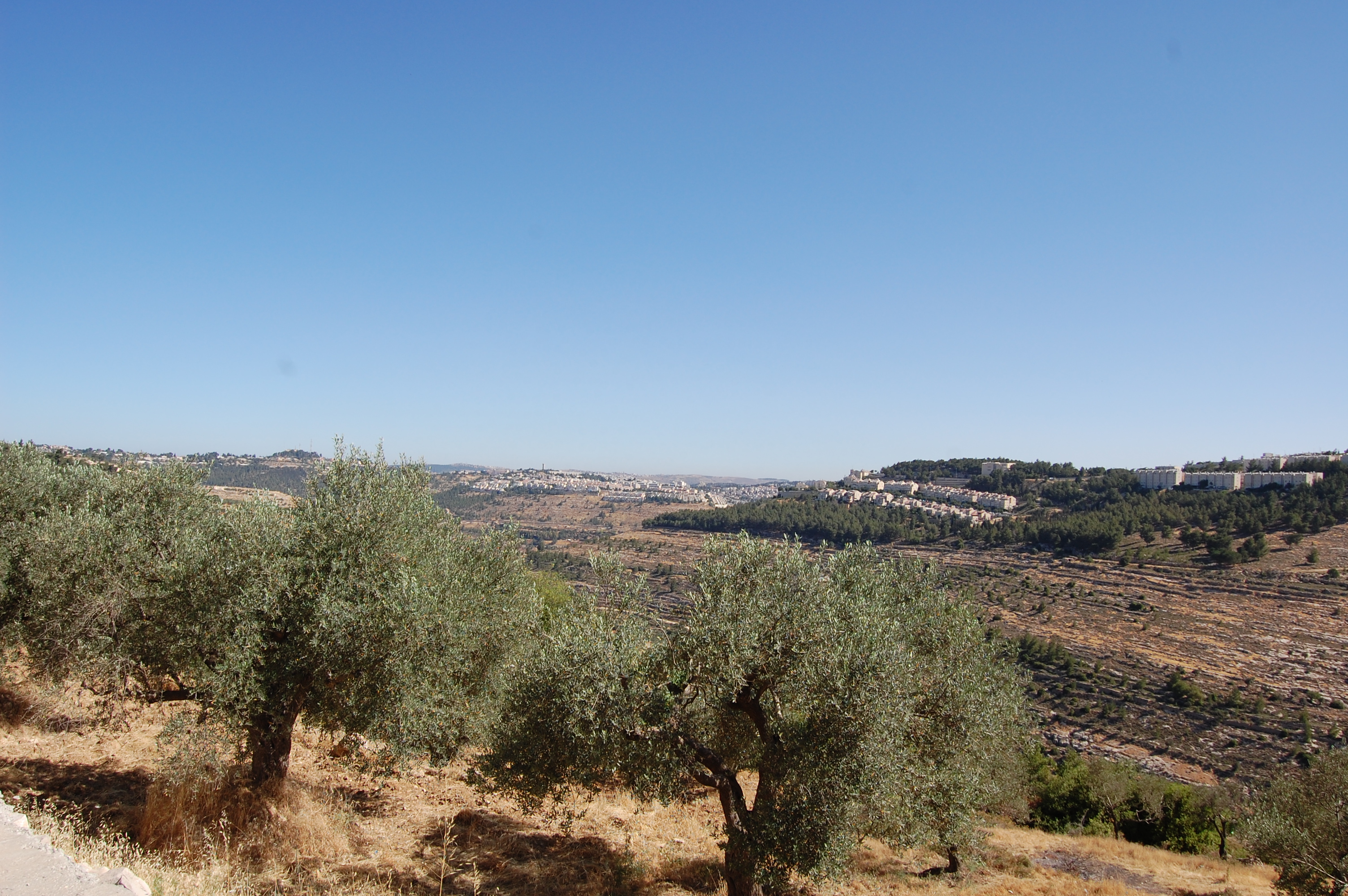
31 DecWhile on pilgrimage in the Holy Land in June 2012 with a group of teachers from various schools in our Archdiocese of Cincinnati we celebrated an outdoor Mass in Cremisan Valley in an olive grove. It was then that we met Deacon Sleiman (Solomon), a student at the Latin Patriarchate Seminary who is serving as deacon at Annunciation Church in Beit Jala.
In his car Deacon Solomon led our bus on its way through the village of Beit Jala, up over the hill and around the winding roads, to the Cremisan Valley. In the open trunk of his car, he brought along an altar table, and inside the car he had everything we needed for Mass. He was the perfect host and gentleman. He is, in the words of one of our pilgrim-teachers, a holy man – and he will be a good and holy priest.
As you see him and hear him in this YouTube video, enjoy his smile and his obvious love for the Church. We can assure y0u that he means it when he says, “You are most welcome to be here with us in our Annunication Church in Beit Jala.”
not on Friday, but on Tuesday
15 NovEvery Friday afternoon at 3:00 p.m., with obvious connections to the time of suffering that Jesus endured on the Friday that we call Good, Father Ibrahim Shomali, the parish priest of Beit Jala (Bethlehem) celebrates the Holy Sacrifice of the Mass with his people in an olive grove in Cremisan Valley on the outskirts of the town.
This place is chosen by the parish of Beit Jala for Mass to protest in a prayerful and nonviolent way the proposed path that the Israeli government plans to follow in building another section of the separation wall through this very valley. What the Palestinians (and I) and many Israeli citizens call a separation wall, some proponents prefer to call a security fence, claiming that only 3% of it is actually a wall, and that the rest is a low lying, barbed wire structure. There is no doubt that this section will not be a fence; it will be a wall. And it will separate: 58 families from their olive groves, 450 children from their school at the convent of the Silesian sisters, and all the people of Beit Jala from the only recreational park, green space that is left for them. And it is hard to imagine how this particular re-routing of the wall to take more land and water for Israel is necessary for security.
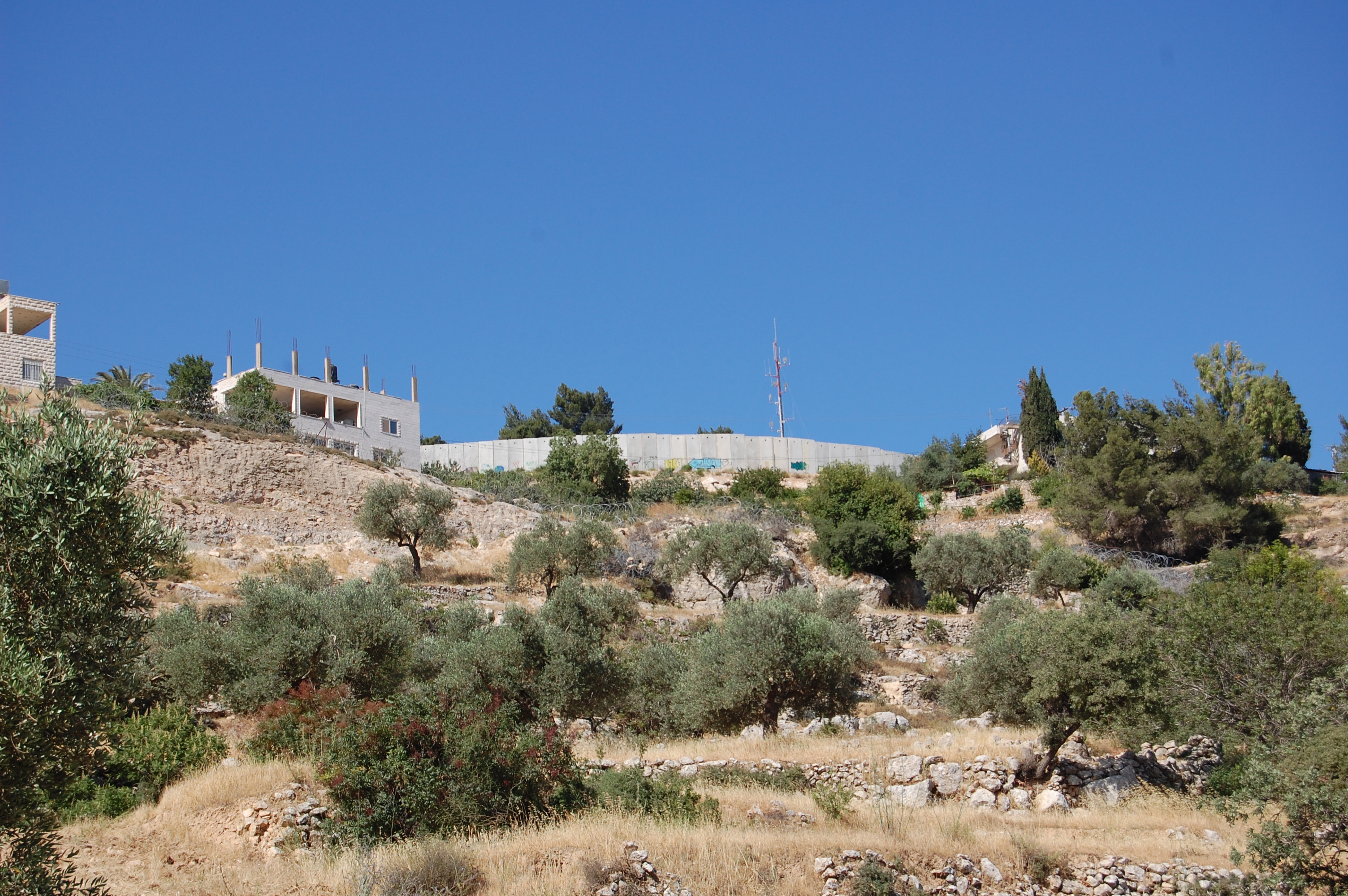
The schedule for our pilgrim-teachers from schools of our Archdiocese of Cincinnati did not allow us to join him/them on Friday, so Father Ibrahim arranged for Deacon Suleiman to accompany us to the place for Mass on a Tuesday morning.

When we arrived, we found the ground turned up and over. Someone had obviously plowed the ground.

It was alleged by some of the locals that the Israeli government had done that to make it difficult to pray there. No matter who did it or why it was done, the turned up ground did make it quite complicated to walk and difficult to stand, the slightest shift of our weight causing our feet to slip from underneath us. The situation made us more determined in our prayer. We stood our ground as best as we could.
Deacon Suleiman called us to worship with a reminder that Jesus prayed on the night before his crucifixion in another grove of olive trees: at the base of the Mount of Olives in Jerusalem. These olives trees are a Gethsemane of another kind. Here the agony of the garden continues.
We prayed that the agony of our friends from Beit Jala will be eased.
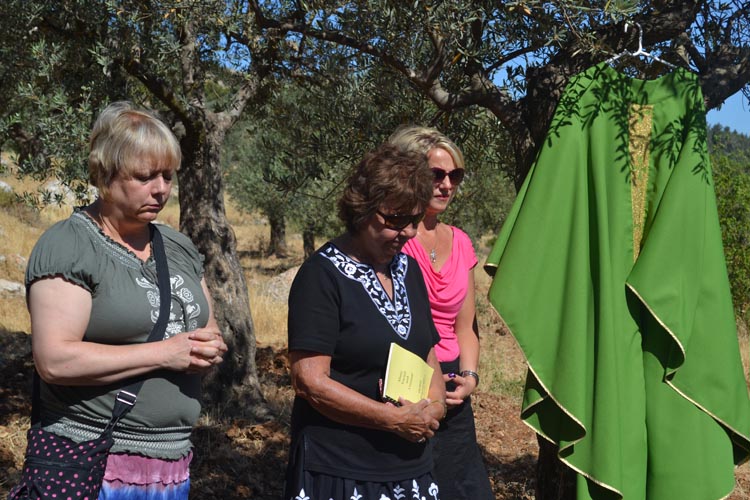

As we left, some of us picked up stones and olive branches, not knowing whether or not we will ever be able to return with them to this place.


Photos Worth Thousands of Memories
7 Jul 
Photo by Dan Campbell
To say that he has the patience of a fisherman, the eyes of an artist and the precision of a surgeon might be a bit of a Middle Eastern overstatement, but he is a very good photographer. Mark Bowen accompanied the second group of HOPE pilgrim-teachers from Cincinnati to the Holy Land, having also been with the first group in 2010.
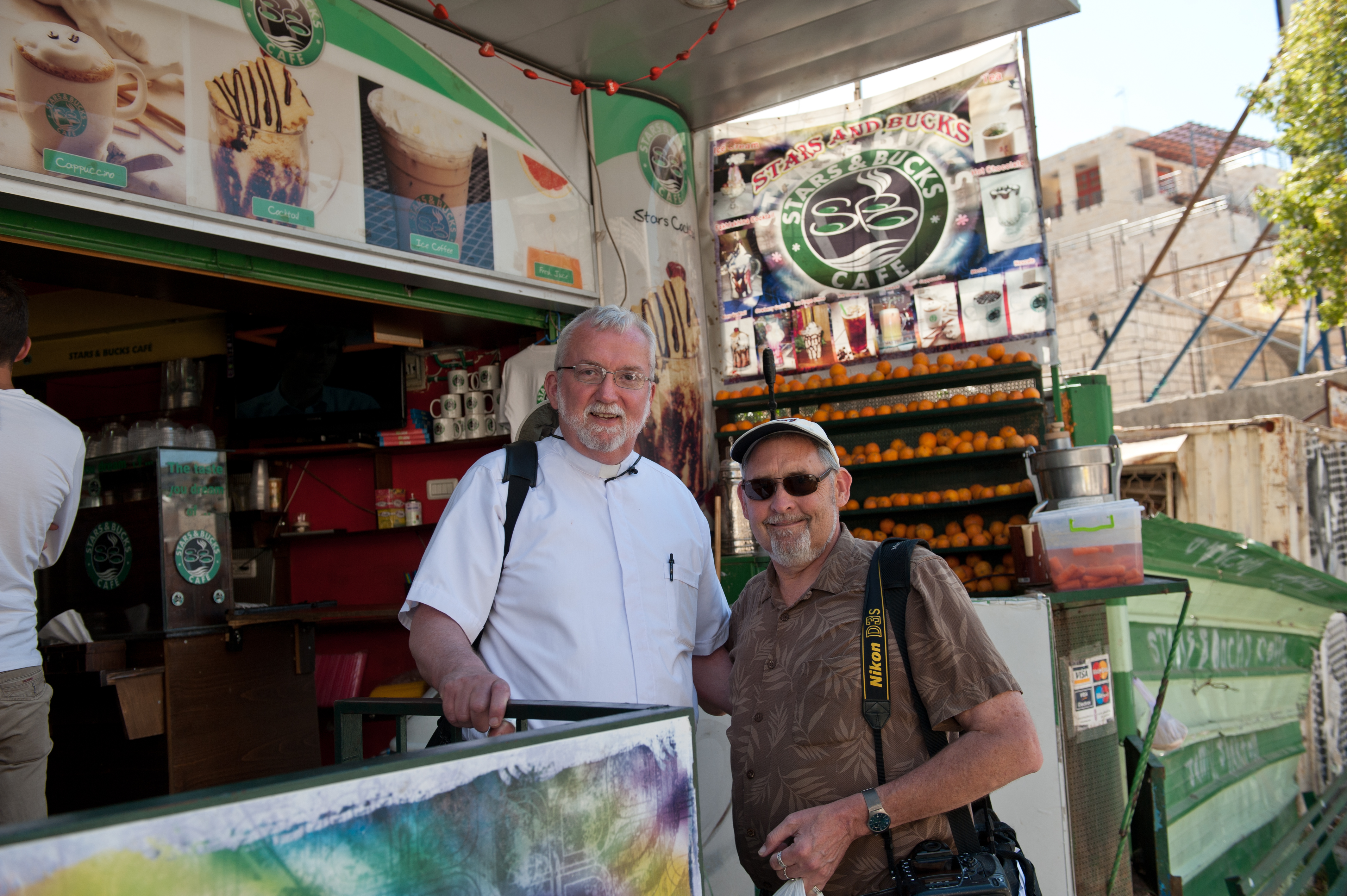
Most often Mark is on the lens side of the camera. But once in a while he sets up the picture, turns his camera over to someone else, and is actually in the photo himself, like in this one taken by the café-keeper at Stars and Bucks in Bethlehem.
 He was also coaxed into being in this group photo, taken in Nazareth by our guide Rami on Jen’s camera.

Being himself quite taken by an event or a site, he is even known to have allowed his picture to be taken by someone else with their own camera, like this one by JoAnne at the Jordan River.
On a rare occasion, difficult to imagine but true, he has even “asked” someone else to use “his” camera to take his picture, like this one taken with Archbishop Elias Chacour at Mar Elias School in Nazareth.

Most often, though, people caught Mark, as he so often caught many of us, doing what he did best: taking pictures, and editing and saving and posting pictures, like in this one by JoAnne in Amman, Jordan
 and in this one by JoAnne on the Sea of Galilee
 and in this one by Cindy on the Sea of Galilee

and in this one by JoAnne at the Gloria Hotel in Jerusalem
 and in these two by Father Rob.
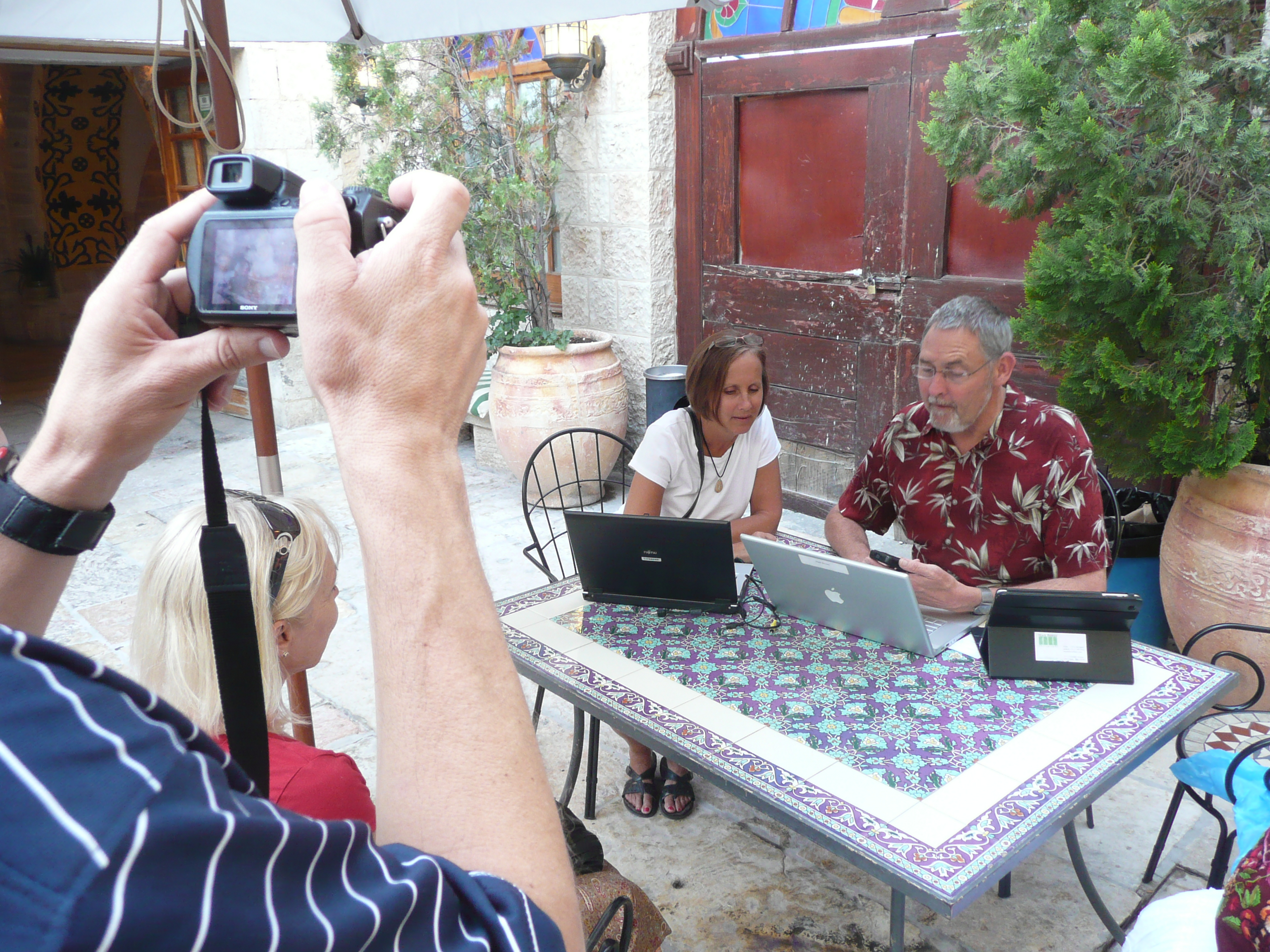

All that being shown and said, Mark has done a remarkable service and a remarkably good job of capturing the moments, the people, the emotions and the HOPEs of our Cincinnati teacher-pilgrims and our Palestinian teacher-friends during the HOPE Pilgrimage 2012. Acknowledging Mark’s work on the back end of so many photos and memories, on the front end we all want to express to him our gratitude, appreciation and admiration.
By the way, Mark, “Mom” (Nancy) especially wants you to know how much she loves you, as can be seen on her face (and yours) in this photo of the two of you, taken by JoAnne at the Dome of the Rock.
“Stars and Bucks” in Bethlehem
1 Jul Mark (the photographer) and I (the priest) decided to walk from the Church of the Nativity to our Sancta Maria Hotel. We left the flow of the pilgrims, as they headed toward the bus for the ride home. I told Mark that I wanted to stop at Stars and Bucks. Always anxious to get a shot that other eyes might not see, he eagerly tagged along.

Our first stop along the way was for twelve pictures (he couldn’t take just one) of a man making falafel at his street-side open restaurant. Amazing how a vat of hot grease and balls of seasoned, crushed garbanzo beans becoming falafel brings joy to a photographer.

Shortly after we rounded the corner Mark shouted out, “Oh no, it is Stars and Bucks.” He saw the sign hanging over the café down the street a bit. He thought I was going to Starbucks, and was teasing him with the name. Would I tease about such a serious matter? 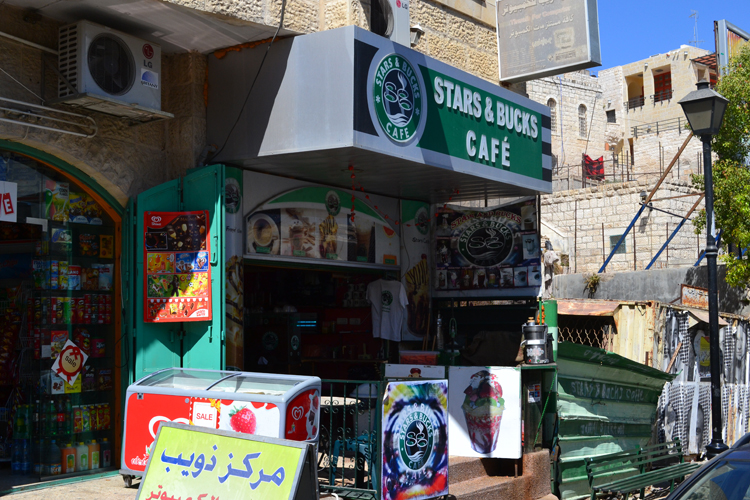
The shop is on the main road in Bethlehem that leads right to Manger Square and the Nativity Church, the site of the birth of Jesus.

Most tourists and pilgrims zip right past the café in a taxi, or walk up the inclined hill on the opposite side of the street because of the location of the garage where all the giant tour busses have to park. But it was the goal of the walk Mark and I were taking … Stars and Bucks.

As I walked into the café and saw that they had coffee mugs for sale, I gave out my own acclamation in the little town of Bethlehem, “Yes!” I had joy like the shepherds and the angels on Christmas eve in the fields of sheep and shepherds. Well, that may be a bit overdone.
My buddy Paul has a collection of Starbucks mugs (see yesterday’s post), but he does not have, and not many people in the whole world have a coffee mug from Stars and Bucks in Bethlehem, Palestine.
Mark bought two mugs, one for his daughter and her husband. I bought one for Paul, and one for myself. Mark was enjoying the moment so much he agreed to get into a picture, and gave his camera to one of the keepers of the café, who seemed a bit puzzled by the performance being played out in his sleepy shop.
My regrets are that I didn’t sit down for coffee and conversation with the locals, and that I didn’t buy a whole case of the mugs. I could have left a lot of clothes behind to have room for them in my return suitcase. I have something to add to my itinerary the next time.

Photos 2, 3 by Mark Bowen/HOPE. Photos 4, 5, 6 by Waseim/Beit Jala. Photos 1, 8 by Father Rob/Milford. Phot0 7 by Stars and Bucks Café Keeper/Bethlehem, using camera of Mark Bowen/HOPE. Phew! Everybody gets due credit.
Privacy at Amman Starbucks
30 JunMy friend, Paul, has a collection of Starbucks coffee mugs from places where work has taken him, beginning at Seattle, from the Pike Place Market, where Starbucks started, and continuing throughout China, with names of cities on the mugs that only he at Sunday supper can pronounce – all made in China, of course.
One of my goals on pilgrimage to the Holy Land was to bring back for him a Starbucks mug from somewhere in the Middle East. There are no Starbucks in Israel or in Palestine. So, my best bet was Jordan.
Our pilgrim group was taken to a mall in Amman, Jordan, to kill some time, for we were ahead of schedule, and too early for our next appointment on the itinerary, which was not, believe me, a frequent occurrence for us. The mall was huge. 
And there it was, right inside the entrance: Starbucks.
The mug was easy to buy. My American Express card didn’t care if the purchase were in Jordanian dinars or in U.S. dollars. Plastic is plastic, money is money, and it knew it could add a foreign transaction fee to the statement at the end of the month.
But the taking of a photo was not as easy.
As I came out of the store, delighting in my perfect gift for Paul, and pointed my camera at the English and Arabic sign under which I had just walked, two security guards came at me waving their arms, as if I had just pointed a gun at someone. The best I could understand was that photos were not permitted. They seemed satisfied, when they saw me putting my camera away. But our Jordanian guide, approaching out of nowhere in some sort of rescue operation, was not so satisfied.
For us English-speaking Americans, it always seems that the Arabs are arguing, whenever they are speaking to each other, so fast and animated are their words and the movements of their arms. After a time of watching their argument, I mean, conversation, during which I was feeling more than a bit foreign and uneasy, “Give me your camera,” insisted the guide. I asked what the problem was. He quickly explained that they said they wanted to protect the privacy of everyone who came into the mall, and that pictures were not allowed. “Give me your camera, and go stand over there.” Apparently, he either won the argument or was refusing to admit that they had won. Maybe he convinced them that he was not taking anyone else’s picture, just mine, and that the store just happened to be behind me.
I was just happy when the whole thing was over.
You already got your mug, Paul. Here is the mug shot that almost got me mugged. 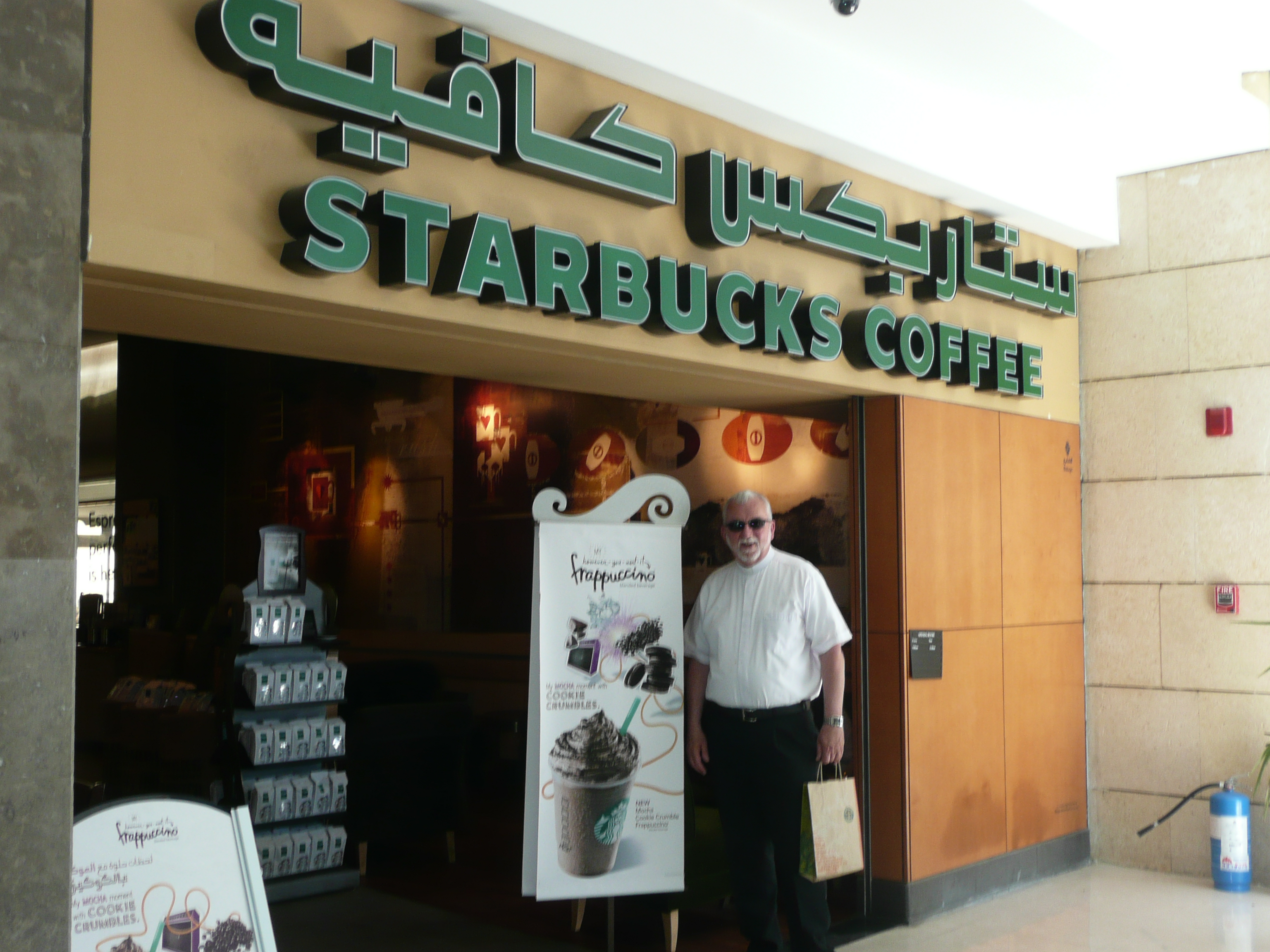
Bless the One who shapes your beauty
7 Mar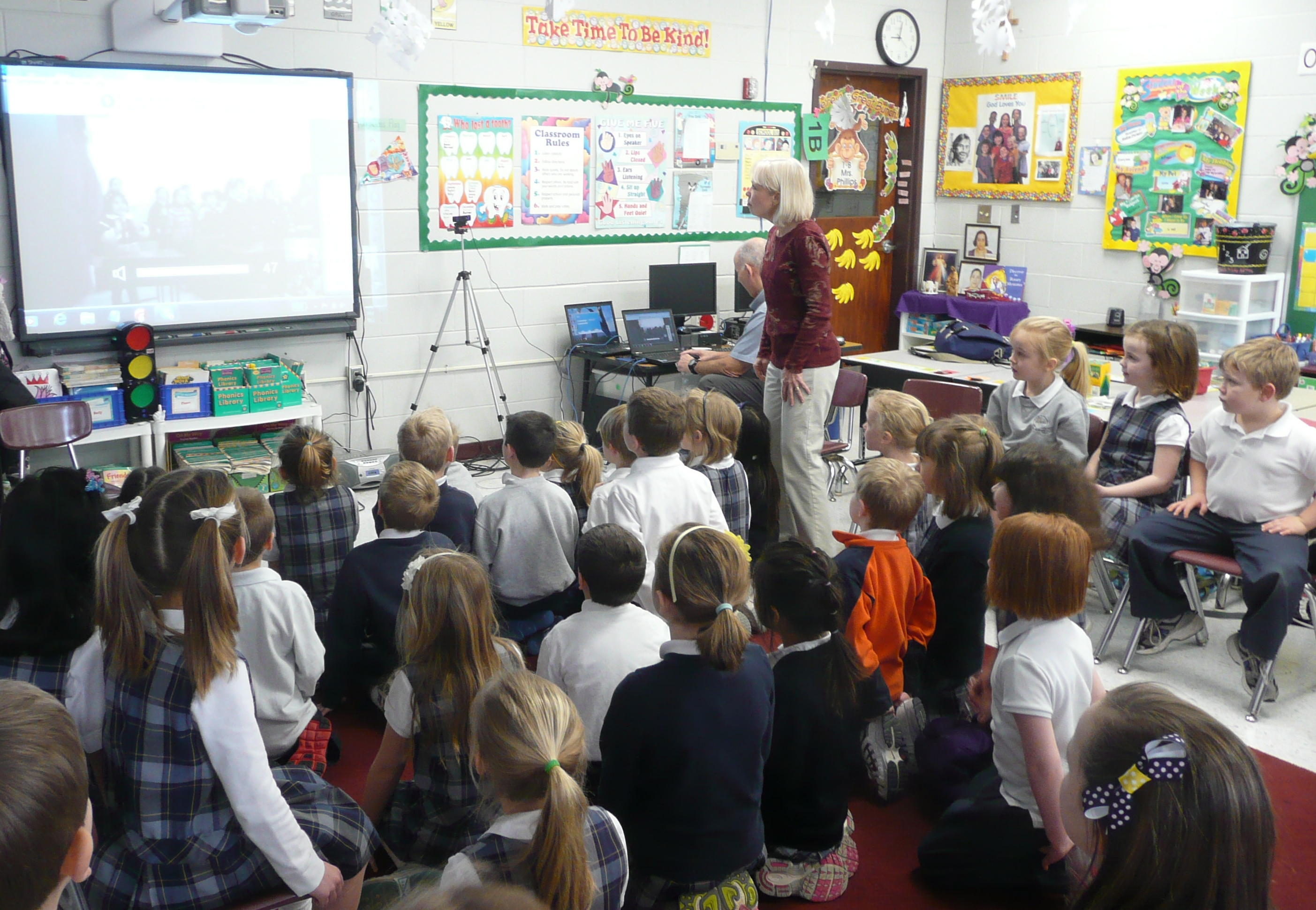
As they waited for the Skype connection with the 1st grade students of Miss Ruya from the Latin Patriarchate School of St. Joseph in Nablus (West Bank, Palestine), Mrs. Phillips explained to her students that the children that they were going to meet were 6,000 miles away, and lived near Bethlehem.
The parents in Palestine had brought their children back to school a couple hours after school was out in order to Skype with our children from America.

The Palestinian children had a song ready – “Twinkle, twinkle, little star.” Our children clapped with joy, probably because they recognized the song. They probably didn’t realize how extraordinary it was that 6-7 years olds, whose first langauge is Arabic, were singing in English. Later, the same children would sing a song in Arabic, which Miss Ruya explained was about how they loved their country very much.
The teachers on both sides of the world tried to put some order into the energy and the enthusiasm of their students. Sometimes they were even successful. First graders, wherever they are, are first graders!

When it was our turn, the CD player went on, and our friends in Palestine heard, “All you works of God / Every mountain, star and tree / Bless the One who shapes your beauty / Who has caused you all to be / One great song of love and grace / Ever ancient, ever new / Raise your voices, all you works of God.”

Mrs. Phillips sang.
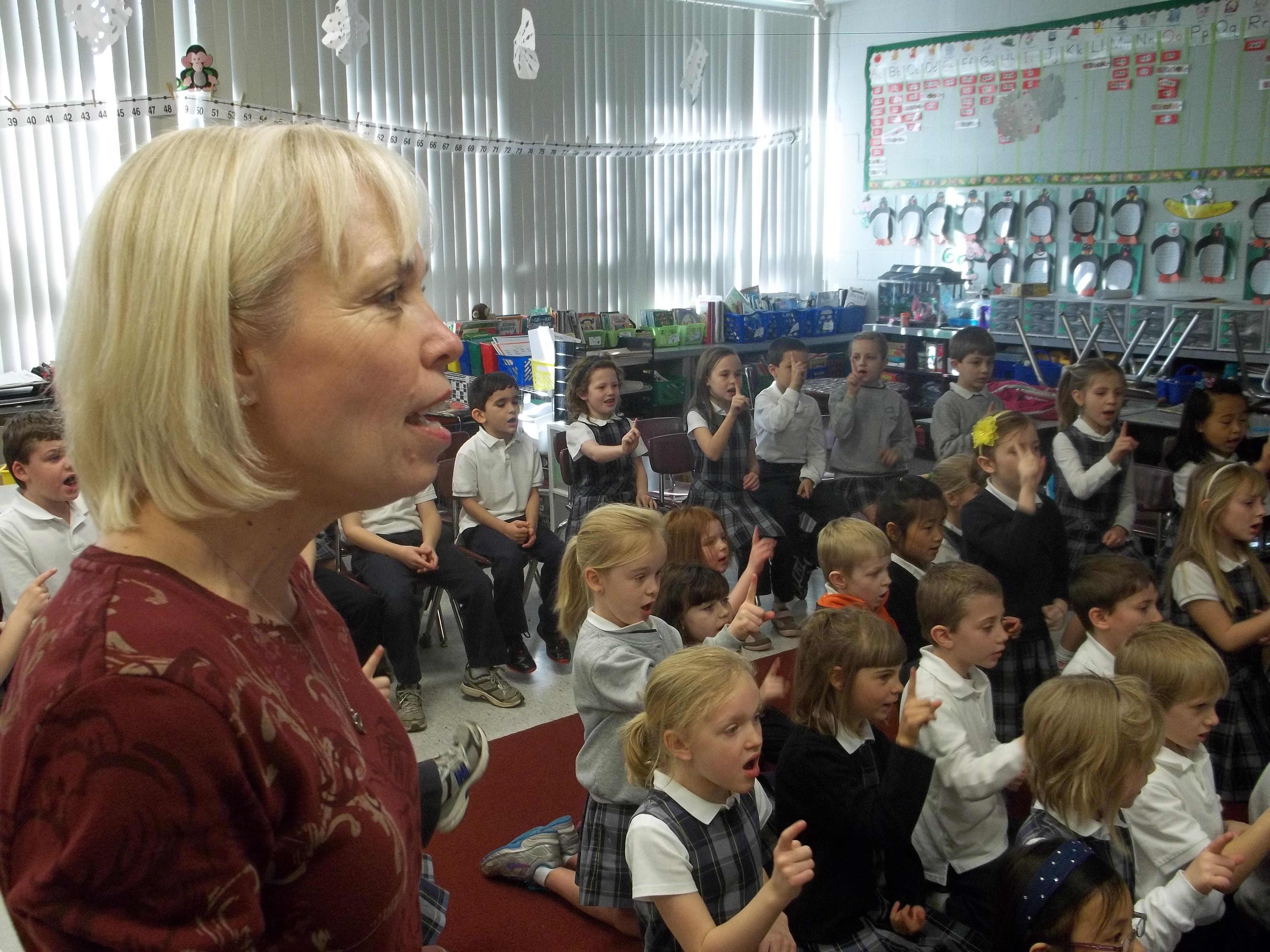
The children sang and made hand gestures that expressed the words of the song.

The Arab children clapped with as much enthusiasm and appreciation as our children did.
They asked questions …

… and waited for answers.

There were questions (and answers) about snow, favorite sports, how old they were.
At the end of the visit, Mrs. Phillips spoke with the principal, Miss Abeer, who personally visited Mrs. Phillips classroom back in October. In June, Mrs Phillips goes to Miss Abeer’s school – and the circle of friendship will be complete.

“We are not killing, fighting, just praying”
27 Feb
One day I will celebrate Mass on a Friday afternoon in an olive grove in Beit Jala with Father Ibrahim Shomali in prayerful protest of the land confiscation and the building of the separation wall at the Cremisan monastery, ensha’allah (God willing).
Father Shomali is the parish priest of the Catholic Church of the Annunciation, in which I have celebrated Mass on several occasions. I have enjoyed the hospitality of the Latin Patriarchate seminary, which is connected to the parish church in Beit Jala, and at which I have been honored to speak to the new seminarians under the care of Father Faysal Hijazeen shortly after their arrival for the new school year. I have visited the children and teachers at the Latin Patriarchate School on numerous occasions, and in 2008 I was humbled and delighted with an invitation to address the high school graduates and their families at the graduation ceremony on the outdoor plaza overlooking Bethlehem. I have walked from the Beit Jala parish to the Cremisan monastery to buy wine to bring home with me. I know Beit Jala. I know the people of Beit Jala and I know Father Ibrahim, and am blessed to be able to call them my friends.
They need my prayers – and yours! They deserve my attention – and yours!
At the Friday afternoon Mass they are not killing, fighting – just praying.
 With Open Doors