Archive | HOPE 2014 Pilgrimage RSS feed for this section

the prayer of the Lord

23 Apr

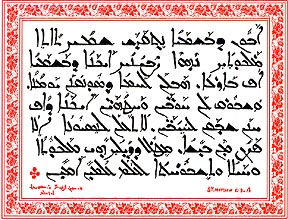
Father Elias Tabban, parish priest of Jaffa of Nazareth, Israel, visited with us in October 2013. Father prays the Our Father, the Lord’s Prayer, in Aramaic, the language in which Jesus prayed and taught his disciples to pray.

“Lord, teach us to pray.”

Lord's prayer in Aramaic

where is your Galilee?

21 Apr

Pope Francis Galilee

Pope Francis Easter Vigil Homily

April 19, 2014

The Gospel of the resurrection of Jesus Christ begins with the journey of the women to the tomb at dawn on the day after the Sabbath. They go to the tomb to honor the body of the Lord, but they find it open and empty.

A mighty angel says to them: “Do not be afraid!” (Mt 28:5) and orders them to go and tell the disciples: “He has been raised from the dead, and indeed he is going ahead of you to Galilee” (v. 7). The women quickly depart and on the way Jesus himself meets them and says: “Do not fear; go and tell my brothers to go to Galilee; there they will see me” (v. 10).

After the death of the Master, the disciples had scattered; their faith had been utterly shaken, everything seemed over, all their certainties had crumbled and their hopes had died. But now that message of the women, incredible as it was, came to them like a ray of light in the darkness.

The news spread: Jesus is risen as he said. And then there was his command to go to Galilee; the women had heard it twice, first from the angel and then from Jesus himself: “Let them go to Galilee; there they will see me”.

Galilee is the place where they were first called, where everything began! To return there, to return to the place where they were originally called. Jesus had walked along the shores of the lake as the fishermen were casting their nets. He had called them, and they left everything and followed him (cf. Mt 4:18-22).

To return to Galilee means to re-read everything on the basis of the cross and its victory. To re-read everything – Jesus’ preaching, his miracles, the new community, the excitement and the defections, even the betrayal – to re-read everything starting from the end, which is a new beginning, from this supreme act of love.

For each of us, too, there is a “Galilee” at the origin of our journey with Jesus. “To go to Galilee” means something beautiful, it means rediscovering our baptism as a living fountainhead, drawing new energy from the sources of our faith and our Christian experience.

To return to Galilee means above all to return to that blazing light with which God’s grace touched me at the start of the journey. From that flame I can light a fire for today and every day, and bring heat and light to my brothers and sisters. That flame ignites a humble joy, a joy which sorrow and distress cannot dismay, a good, gentle joy.

In the life of every Christian, after baptism there is also a more existential “Galilee”: the experience of a personal encounter with Jesus Christ who called me to follow him and to share in his mission. In this sense, returning to Galilee means treasuring in my heart the living memory of that call, when Jesus passed my way, gazed at me with mercy and asked me to follow him. It means reviving the memory of that moment when his eyes met mine, the moment when he made me realize that he loved me.

Today, tonight, each of us can ask: What is my Galilee? Where is my Galilee? Do I remember it? Have I forgotten it? Have I gone off on roads and paths which made me forget it? Lord, help me: tell me what my Galilee is; for you know that I want to return there to encounter you and to let myself be embraced by your mercy.

The Gospel of Easter is very clear: we need to go back there, to see Jesus risen, and to become witnesses of his resurrection. This is not to go back in time; it is not a kind of nostalgia. It is returning to our first love, in order to receive the fire which Jesus has kindled in the world and to bring that fire to all people, to the very ends of the earth.

“Galilee of the Gentiles” (Mt 4:15; Is 8:23)! Horizon of the Risen Lord, horizon of the Church; intense desire of encounter…. Let us be on our way!

stay at the table

21 Apr

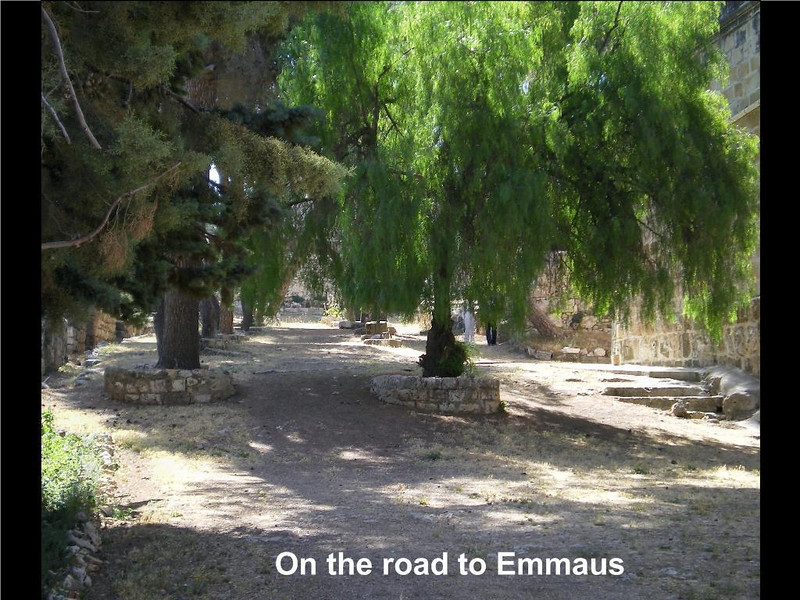
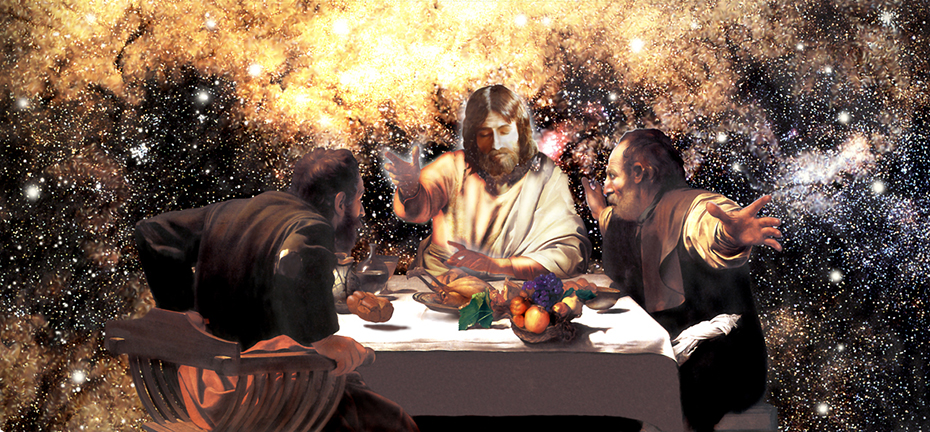
Road to Emmaus 01

even on this day after Easter Sunday, there  can be dashed hopes. We wonder what God has in mind sometimes, if indeed he is thinking about us at all. We discuss the distress of our days and argue about how today can be fixed and about what tomorrow might be like, if either we or God don’t do something real fast. Among us believers there is conversation today, just as …

Road to Emmaus 02

back then on the very day the disciples received word that others had said that the tomb of Jesus was empty. 

As then, so now, in the midst of disappointments and wonderings, Jesus joins us “on the way” as we debate. Little by little, if we stay with the conversation, he turns our debate into a question and answer session, reminding us about what the plan has been all along and showing us that there is evidence even on this day, incomplete as it is, that the plan is moving ahead and is on schedule. 

Showing himself to us in the breaking of the bread, he simply asks us to “stay at the table.”

Road to Emmaus 03


keep hope and be hope

19 Apr

Keep hope within yourself.

Be hope for someone else.

+ +

+ +

Be hope for someone else.

Keep hope within yourself.


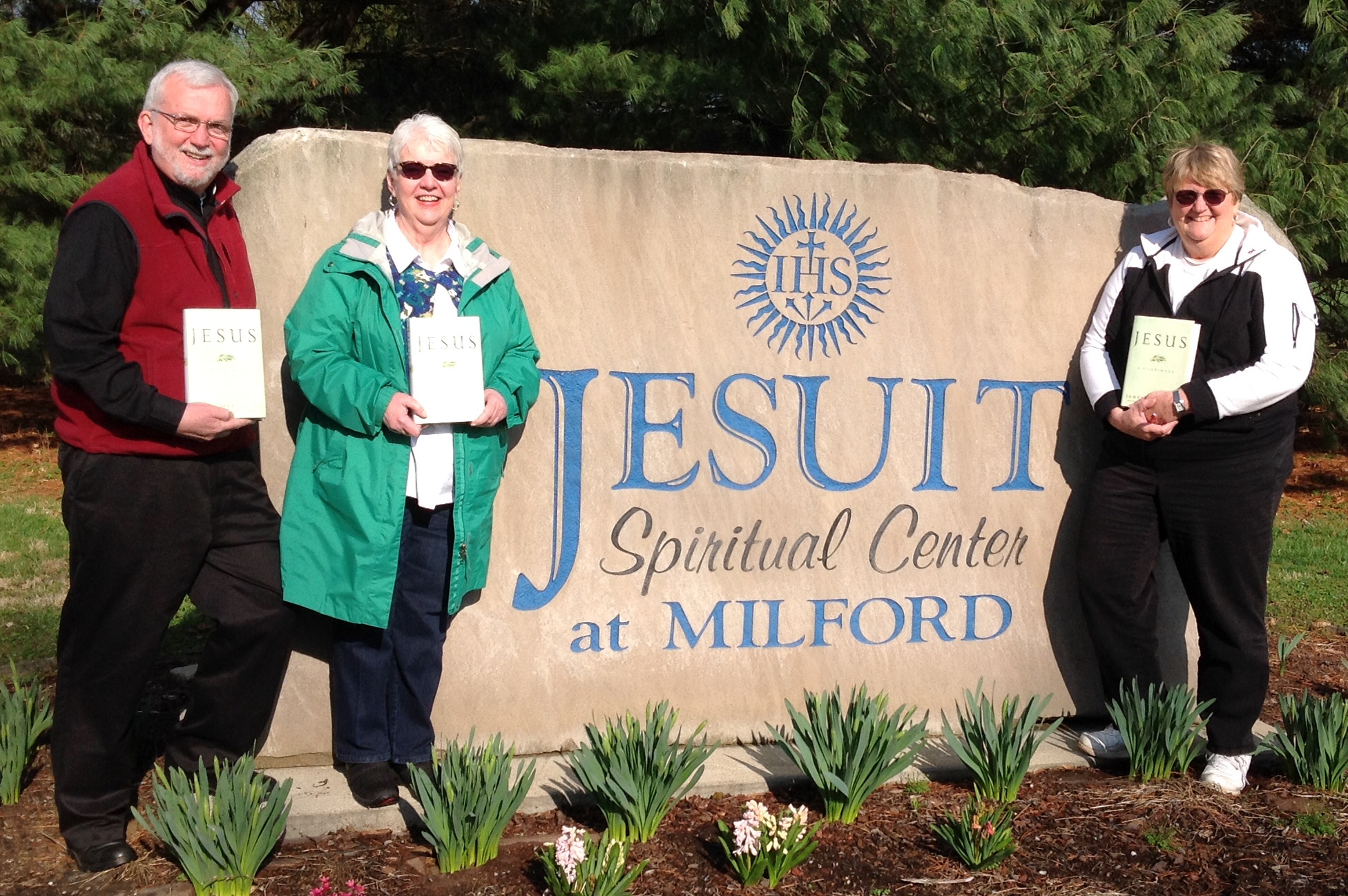
with “Jesus” and @JamesMartinSJ – in Milford

8 Apr

Jesuit Renewal Center James Martin book

We are with “Jesus” at a “Jesuit retreat house near Cincinnati, Ohio” (page 226 of “Jesus: A Pilgrimage” by Father James Martin, S.J.) – our Milford.

hope gone / unexpected dawn

6 Apr

At our “Community Fare” luncheon today, I will interview in talk show fashion four women who have met and become friends through grief: each has buried her husband.

On this Fifth Sunday of Lent we will use the Raising of Lazarus, with hearty reference to his sisters Martha and Mary, as our conversation prompt. I have prepared eight questions, which I will ask one by one of our panel of believers to help them tell their faith story.

lazarus 1

1. How long have you been without your husband – and – how long was his dying process?

lazarus 2

2. When her brother Lazarus was dying, Martha called for Jesus, and when Lazarus had died, Martha ran to Jesus, all the time knowing that Jesus could change the situation. How did your “running to Jesus” make your situation change?

lazarus

3. One could guess that, once Lazarus was brought back to this life, Lazarus and his sisters lived life differently after that moment – and that each of them, Lazarus, Martha and Mary, would approach their own death differently. Since your experience of accompanying your husband in his passing, how do you live life differently now and how might you approach your own dying differently when it comes?

lazarus 1

4. Jesus instructed those near Lazarus to untie him and let him go free. How did you untie your husband and let him go free? How has your family and your parish helped to untie you and let you go free?

lazarus 1

5. Lazarus was brought back to this life. Would you want to bring your husband back?

lazarus 1

6. When Lazarus was resuscitated, Martha and Mary were reanimated. What are you doing now, since your husband’s death, that you never did when he was alive or that you would never have thought that you would have done or could have done?

lazarus

7. In our closing hymn at Mass today, “Jerusalem Our Destiny,” we sang in the fifth verse, “To the tombs I went to mourn the hope I thought was gone / Here among you I awoke to unexpected dawn.” Can you relate to that in any way?

lazarus

8. Martha put her faith into words. How do you finish the sentence that she began “I have come to believe that …?”

motto and logo for Pope’s pilgrimage to the Holy Land

27 Mar


our andrew

Motto and logo for Pope’s pilgrimage

The Assembly of Catholic Ordinaries of the Holy Land (AOCTS) decided on the motto and logo for the Pope’s upcoming pilgrimage to the Holy Land at the meeting of the Assembly on March 11 and 12, 2014 in Tiberias.

So that they may be one

The motto for the pilgrimage is “So that they may be one”.  The Holy Father has insisted that at the center of his pilgrimage will be the meeting with Greek Orthodox Patriarch Bartholomew of Constantinople and the heads of the Churches in Jerusalem. This is to commemorate and renew the commitment to unity expressed by Pope Paul VI and Patriarch Athenagoras of Constantinople 50 years ago in Jerusalem.

This gives expression to the desire of the Lord at the Last Supper: “I ask not only on behalf of these, but also on behalf of those who will believe in me through their word, that they may all be one.  As you, Father, are in me and I am in you, may they also be in us, so that the world may believe that you have sent me. The glory that you have given me I have given them, so that they may be one, as we are one, I in them and you in me, that they may become completely one, so that the world may know that you have sent me and have loved them even as you have loved me.” (John 17:20-23).

The logo also expresses this desire for unity, representing the embrace of Saint Peter and Saint Andrew, the first two disciples called by Jesus in Galilee. Saint Peter is the patron of the Church in Rome and Saint Andrew is the patron of the Church in Constantinople.  In Jerusalem, in the Mother Church, they embrace. The two apostles are in a boat that represents the Church, whose mast is the Cross of the Lord. The sails of the boat are full of wind, the Holy Spirit, which directs the boat as it sails across the waters of this world.

The unity of Christians is a message of unity for all humanity, called to overcome the divisions of the past and march forward together towards a future of justice, peace, reconciliation, pardon and fraternal love.

This article, information about the Holy Land, and everything about the Pope’s visit to the Holy Land, 24-26 May 2014 can be found on the official web site: Pope Francis in the Holy Land 2014.


and the angels held their breath

25 Mar

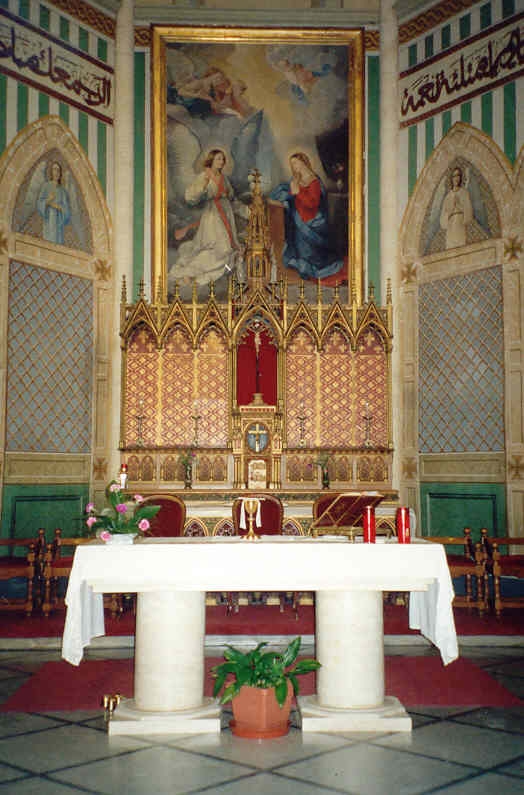
z 070 Beit Jala Annunciation Church Greenberg 08

The Catholic parish in Beit Jala (Bethlehem) is the Church of the Annunciation. Today, March 25, the Solemnity of the Annunciation, is the parish’s patronal feast day. Adding to the celebration is the fact that it is the birthday of their pastor, Father Ibrahim. A big day it was this year. The school children had a day off from classes. The teachers had a retreat day with Bishop Shomali. There was a special Mass. There was a parish dinner. And there was tembola – bingo! z 072a the Sanctuary

It is said that, when Gabriel appeared to Mary in Nazareth and asked Mary if she were willing to be the virgin mother of God’s own Son, there was a moment of suspense between the question and the answer – and the angels in heaven held their breath!

At tembola (bingo) after dinner today in Beit Jala at the Church of the Annunciation another angel of God, Jouelle, held her breath. She was waiting for number “19” to be called. She would have had a “full house” (a cover all). But someone else called “khallas” (stop) before her last number was called.

 Beit Jala feast day March 25, 2014 02

Jouelle, you did not win the prize at tembola. But I hope that seeing your picture on my blog helps you to feel better.

Now, get ready, Jouelle, to shout, because here comes …

Beit Jala feast day March 25, 2014 03

it’s like I’m married to them

23 Mar

The well was the biblical meeting place, where one often met a future spouse. Many a couple still meet at a watering hole, but, of course, where the drink of preference is not water.  A well was the Old Testament version of eharmony.com.Jacob well 02

Jacob met his wife Rachel when she came to the well at noon. He did not win her immediately. It took some doing.

 Jacob well 01

Jesus sat at Jacob’s well at about noon, when a woman arrived. It is no wonder that the disciples were a bit surprised and stressed to see the two of them together at the well. It is also no wonder that the conversation turned towards marriage. But the conversation is about marriage of a different kind.

Jesus had come through Samaria on purpose and for a purpose: to woo the people of Samaria into a right relationship, to win them over. As we hear the conversation about, “Get your husband … I have no husband … you are correct, you have had five … and the one you are with now is not your husband,” we imagine Jesus fighting  the inclination to end, “not yet!” We know what he has in mind. And we know who she is with right now, who is not her husband, yet: Jesus. 

Rather than thinking of a woman walking down the aisle five times, each time to meet her man in a wedding ceremony, and five times being disappointed, think: marriage between God and his people, Christ wedded to the Church, the community of believers being the Bride of Christ, who is the Spouse of the Church. 

Jesus had come through Samaria to win the Samaritans into a “marriage” that would be life-giving and eternally lasting, not like the five “marriages” that they entered into with the gods and the cultures of the conquering people, which always led to a disappointing life foreign to their Jewish faith. 

Jesus had come to Samaria to win the whole people of Samaria over from their five bad marriages into the one good one – with him! He started with her, and she helped him pull it off. She left the well and went to her home and her town to bring the announcement that there was going to be wedding, not with a dead beat husband, but with the Savior of the world. 

???????????????????????????????

As I went to the well this morning at Mass, it dawned on me that I often speak  to God the same five faults, failings, missteps, habits and sins. I confess the same handful of sins to the priest. It seems like I am married to this handful – these five things – that get me nowhere and keep me from being free and happy.

I must return to the well of Sunday Mass every week to be wooed from my bad five marriages.

Today’s homily is at minute 21:50 of our parish’s “On-Demand Archives” under the titled,Bible eHarmony.com