Archive | Holy Land Outreach to Palestinian Educators RSS feed for this section

8:30 am Milford – and – 3:30 pm Beit Jala

8 Feb

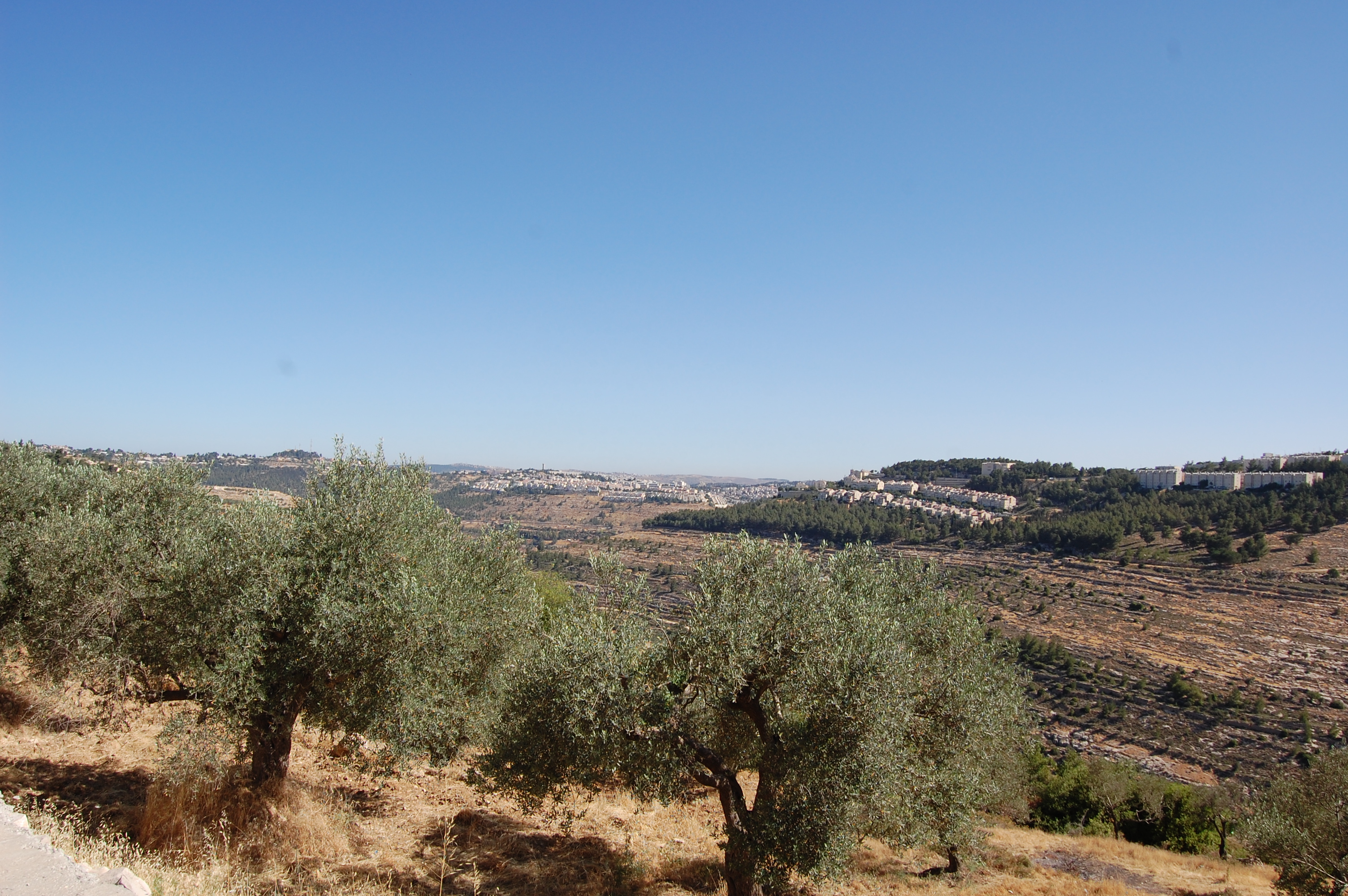
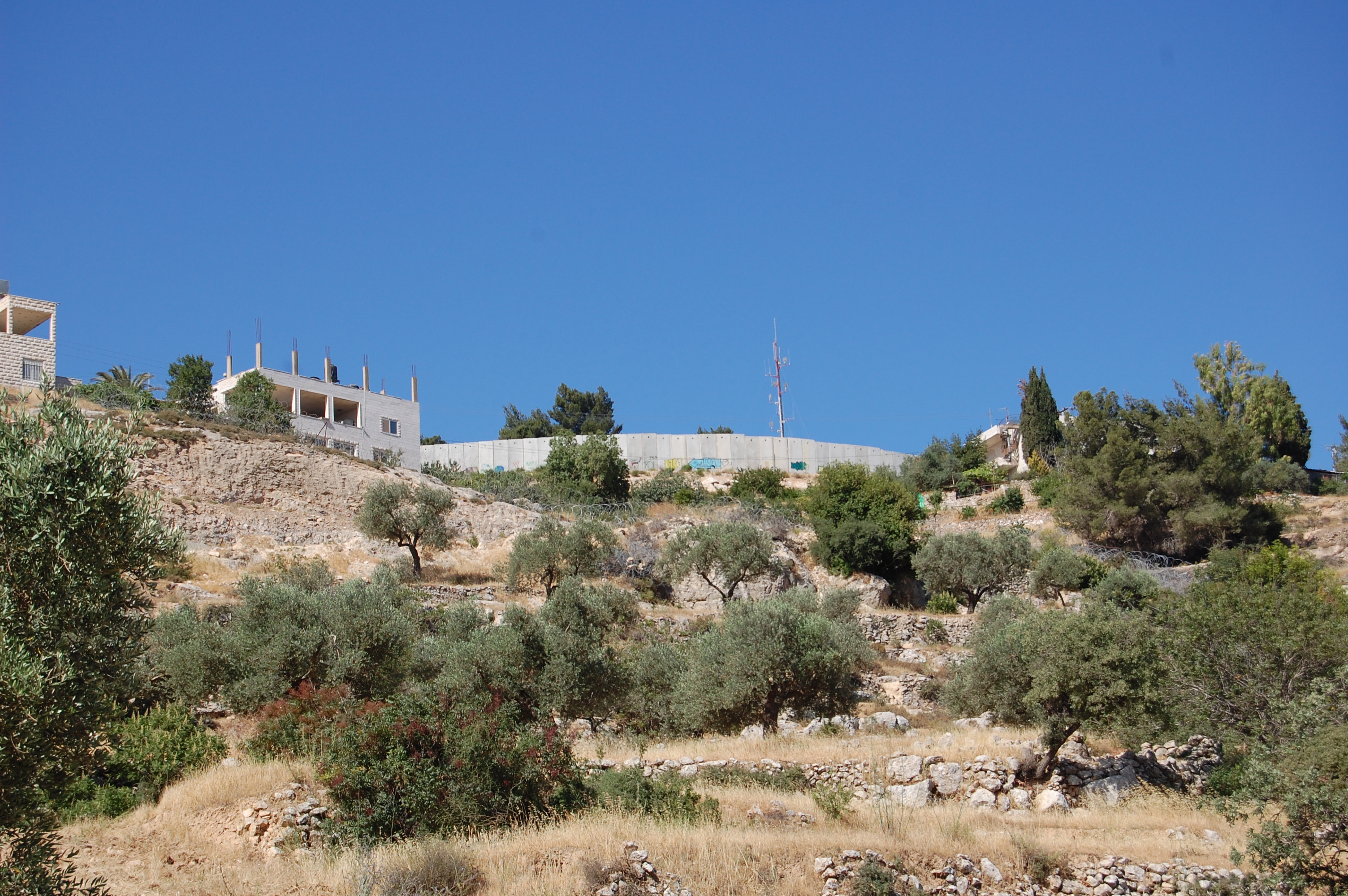
Mass has been celebrated in Cremisan valley every Friday afternoon at 3:30 p.m. in a prayer-protest of a proposed new section of what is called a separation wall by the Palestinians and a security fence by the Israelis. Whether it is for separation or security, it is definitely a wall, and not a fence, in this section of the structure that divides Beit Jala and Jerusalem.

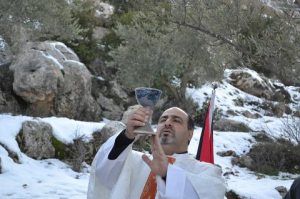
Earlier in January Father Ibrahim Shomali, the pastor of Annunciation Catholic Church in Beit Jala, celebrated the Mass in the cold and snow, after an unusual snowfall a couple days before.fr_ibraheem 2

We see on the altar a blue-green pottery chalice. Father Shomali has used this chalice for the weekly Mass ever since June.

We brought it from Cincinnati as a gift to him and the parish. So, after we used it when we celebrated Mass in that olive grove in Cremisan valley on the edge of the town of Beit Jala in the Bethlehem-area, we left it behind, so that they might remember us in prayer as we remember them in prayer. ibrahin snow bend over 7
Today – Friday, February 8 – will be the last day that Father Shomali will celebrate Mass in that olive grove before the final decision of the Israeli government.  A final decision of the Israeli Court will be handed down on February 12. Will Israel take control of the Cremisan valley? Or will the Cremisan valley remain in the hands of the Palestinians?

PRAY. At 8:30 a.m.(Milford time) pray in solidarity with Father Ibrahim and the people of Beit Jala as they celebrate Mass at 3:30 p.m. (Beit Jala time).

ACT. As urged by the United States Conference of Catholic Bishops, sign the petition that will be taken to Israeli authorities in protest of the proposed building of this section of the wall.
save the valley in Cremisan: online petition

31 Jan

Cremisan school

The Society of St. Yves is the Catholic Center for Human Rights of the Latin Patriarchate (the Roman Catholic Archdiocese) in the Holy Land. The lawyers of this society have been arguing before the Israeli Supreme Court, at the request of the Latin Patriarchate, asking the Court to stop the Israeli government from building a new section of the security fence (separation wall) through the Cremisan valley at the edge of Beit Jala (Bethlehem).

Crem 97 Cremisan ohio_2012m

Last summer I celebrated Mass in Cremisan valley, and wrote about the place in this previous post: “Not on Friday, but on Tuesday.”

The Society of St. Yves outlines the reasons against the building of this section of the wall, and provides an online petition of support for their position that will be sent to Israeli authorities.  Find out more and sign the petition at “Save the valley in Cremisan: Support bridges, not walls!

When I signed the petition, I wrote this as my reason for signing:

Our friends in Israel could clearly express their desire for reconciliation and security for all who live in the land by a decision NOT to build this section of the fence/wall in the Cremisan valley as it is proposed. Just think of the good public relations message that the Israeli government would put out and the good will that they would spread by making it known that they want the Christians to stay, that they want the people of Beit Jala to have a green space in which to rest and play, that they want the people of the area to have access to water, that they do not want the farmers to lose their livelihood, and that they want the children of the valley to feel safe and secure enough to live and learn as all children deserve – by making it known that they will NOT build that proposed wall/fence through the valley of Cremisan. The Israelis and the Israel government have an opportunity here that they do not often have to put their actions where their words are and their hearts where their minds are. An international audience would hear the message. Not building the wall/fence in the Cremisan Valley along the proposed route is a win-win situation for both the Israelis and the Palestinians, and especially for the children on both sides of that fence/wall that now divides them.

Crem 90 Cremisan jen holy land 964 (205)

You are most welcome

31 Dec

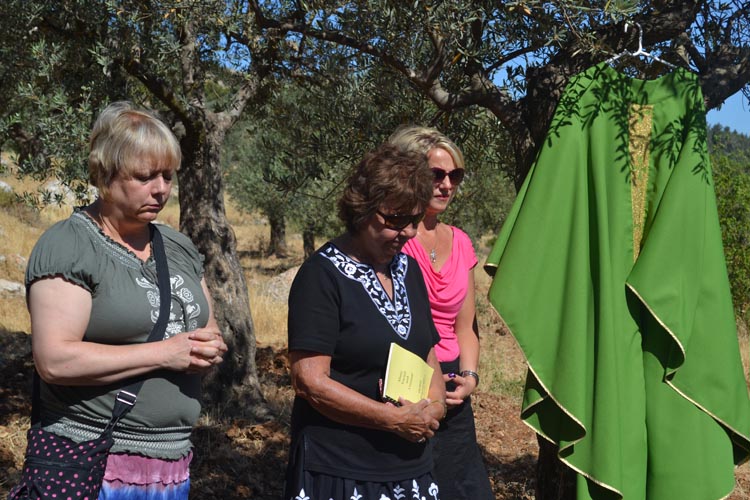
While on pilgrimage in the Holy Land in June 2012 with a group of teachers from various schools in our Archdiocese of Cincinnati we celebrated an outdoor Mass in Cremisan Valley in an olive grove. It was then that we met Deacon Sleiman (Solomon), a student at the Latin Patriarchate Seminary who is serving as deacon at Annunciation Church in Beit Jala.

In his car Deacon Solomon led our bus on its way through the village of Beit Jala, up over the hill and around the winding roads, to the Cremisan Valley. In the open trunk of his car, he brought along an altar table, and inside the car he had everything we needed for Mass. He was the perfect host and gentleman. He is, in the words of one of our pilgrim-teachers, a holy man – and he will be a good and holy priest.

As you see him and hear him in this YouTube video, enjoy his smile and his obvious love for the Church. We can assure  y0u that he means it when he says, “You are most welcome to be here with us in our Annunication Church in Beit Jala.”

not on Friday, but on Tuesday

15 Nov

Every Friday afternoon at 3:00 p.m., with obvious connections to the time of suffering that Jesus endured on the Friday that we call Good, Father Ibrahim Shomali, the parish priest of Beit Jala (Bethlehem) celebrates the Holy Sacrifice of the Mass with his people in an olive grove in Cremisan Valley on the outskirts of the town.

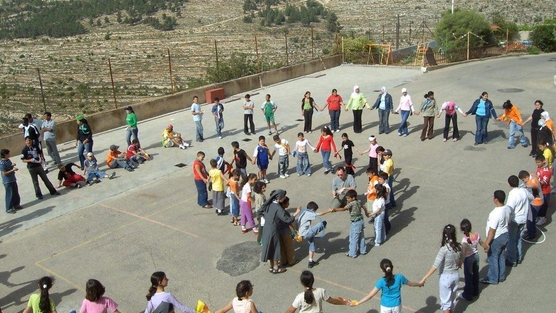
This place is chosen by the parish of Beit Jala for Mass to protest in a prayerful and nonviolent way the proposed path that the Israeli government plans to follow in building another section of the separation wall through this very valley. What the Palestinians (and I) and many Israeli citizens call a separation wall, some proponents prefer to call a security fence, claiming that only 3% of it is actually a wall, and that the rest is a low lying, barbed wire structure. There is no doubt that this section will not be a fence; it will be a wall. And it will separate: 58 families  from their olive groves, 450 children from their school at the convent of the Silesian sisters, and all the people of Beit Jala from the only recreational park, green space that is left for them. And it is hard to imagine how this particular re-routing of the wall to take more land and water for Israel is necessary for security.
The schedule for our pilgrim-teachers from schools of our Archdiocese of Cincinnati did not allow us to join him/them on Friday, so Father Ibrahim arranged for Deacon Suleiman to accompany us to the place for Mass on a Tuesday morning.

When we arrived, we found the ground turned up and over. Someone had obviously plowed the ground.

It was alleged by some of the locals that the Israeli government had done that to make it difficult to pray there. No matter who did it or why it was done, the turned up ground did make it quite complicated to walk and difficult to stand, the slightest shift of our weight causing our feet to slip from underneath us. The situation made us more determined in our prayer. We stood our ground as best as we could.

Deacon Suleiman called us to worship with a reminder that Jesus prayed on the night before his crucifixion in another grove of olive trees: at the base of the Mount of Olives in Jerusalem. These olives trees are a Gethsemane of another kind. Here the agony of the garden continues.

We prayed that the agony of our friends from Beit Jala will be eased.

As we left, some of us picked up stones and olive branches, not knowing whether or not we will ever be able to return with them to this place.

Photos Worth Thousands of Memories

7 Jul


Photo by Dan Campbell

To say that he has the patience of a fisherman, the eyes of an artist and the precision of a surgeon might be a bit of a Middle Eastern overstatement, but he is a very good photographer. Mark Bowen accompanied the second group of HOPE pilgrim-teachers from Cincinnati to the Holy Land, having also been with the first group in 2010.

Most often Mark is on the lens side of the camera. But once in a while he sets up the picture, turns his camera over to someone else, and is actually in the photo himself, like in this one taken by the café-keeper at Stars and Bucks in Bethlehem.  

He was also coaxed into being in this group photo, taken in Nazareth by our guide Rami on Jen’s camera.

Being himself quite taken by an event or a site, he is even known to have allowed his picture to be taken by someone else with their own camera, like this one by JoAnne at the Jordan River.

On a rare occasion, difficult to imagine but true, he has even “asked” someone else to use “his” camera to take his picture, like this one taken with Archbishop Elias Chacour at Mar Elias School in Nazareth.

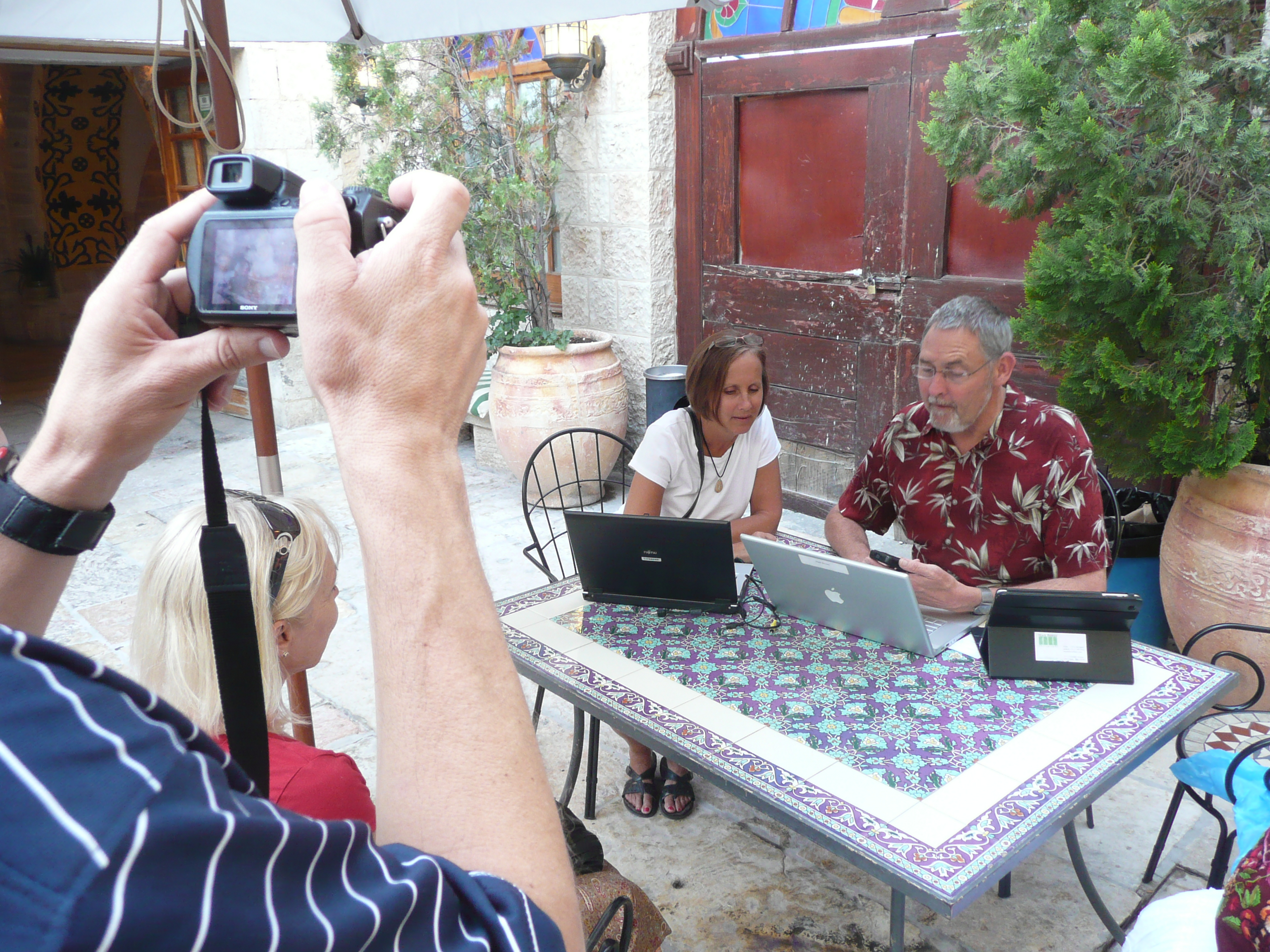
Most often, though, people caught Mark, as he so often caught many of us, doing what he did best: taking pictures, and editing and saving and posting pictures, like in this one by JoAnne in Amman, Jordan

 and in this one by JoAnne on the Sea of Galilee

 and in this one by Cindy on the Sea of Galilee

and in this one by JoAnne at the Gloria Hotel in Jerusalem

 and in these two by Father Rob.

All that being shown and said, Mark has done a remarkable service and a remarkably good job of capturing the moments, the people, the emotions and the HOPEs of our Cincinnati teacher-pilgrims and our Palestinian teacher-friends during the HOPE Pilgrimage 2012. Acknowledging Mark’s work on the back end of so many photos and memories, on the front end we all want to express to him our gratitude, appreciation and admiration.

By the way, Mark, “Mom” (Nancy) especially wants you to know how much she loves you, as can be seen on her face (and yours) in this photo of the two of you, taken by JoAnne at the Dome of the Rock.


My Watch is “Two-Faced”

10 Apr

Usually I wear a wristwatch that has two “faces.” One is set for local, Milford, time – 10:47 a.m. in the photo below. The other is seven hours ahead: 5:47 p.m., which is “Bethlehem time.” I keep myself on track … and I am constantly reminded of my friends in Bethlehem, Beit Jala, Beit Sahour, Nablus, Nazareth and Jerusalem.

Sunday morning as I reached into my dresser drawer for a clean handkerchief, I noticed my “good” watch. I wear it on special occasions. Easter is special! So, onto my wrist went my good watch. As a reminder that Easter Day is actually an Octave, I will wear my special watch for eight days, until next Sunday evening.I can easily and quickly add seven hours to remember whether my friends in the Holy Land are awake or asleep.

Bless the One who shapes your beauty

7 Mar

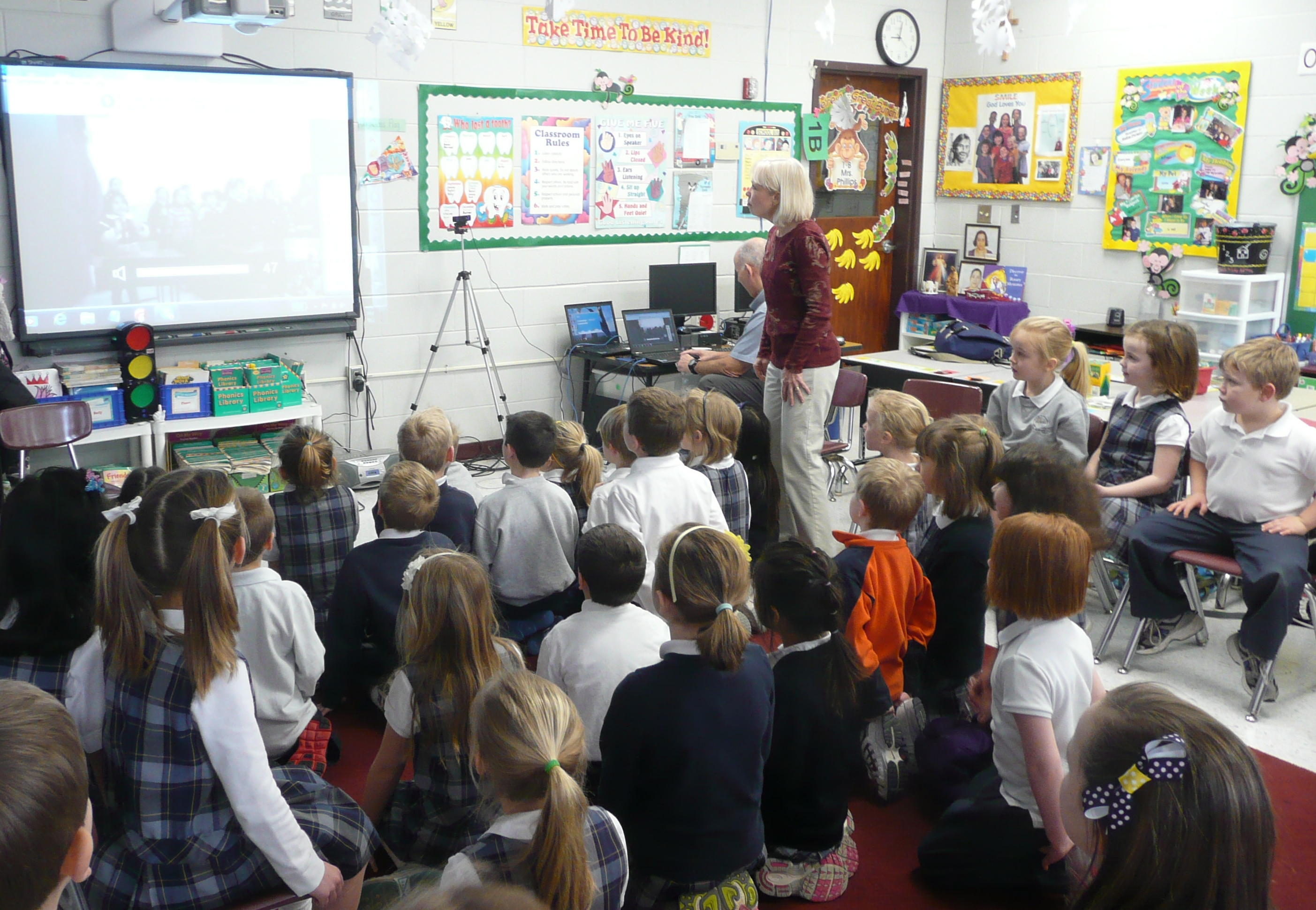
As they waited for the Skype connection with the 1st grade students of Miss Ruya from the Latin Patriarchate School of St. Joseph in Nablus (West Bank, Palestine), Mrs. Phillips explained to her students that the children that they were going to meet were 6,000 miles away, and lived near Bethlehem.

The parents in Palestine had brought their children back to school a couple hours after school was out in order to Skype with our children from America.

The Palestinian children had a song ready – “Twinkle, twinkle, little star.” Our children clapped with joy, probably because they recognized the song. They probably didn’t realize how extraordinary it was that 6-7 years olds, whose first langauge is Arabic, were singing in English. Later, the same children would sing a song in Arabic, which Miss Ruya explained was about how they loved their country very much.

The teachers on both sides of the world tried to put some order into the energy and the enthusiasm of their students. Sometimes they were even successful. First graders, wherever they are, are first graders!

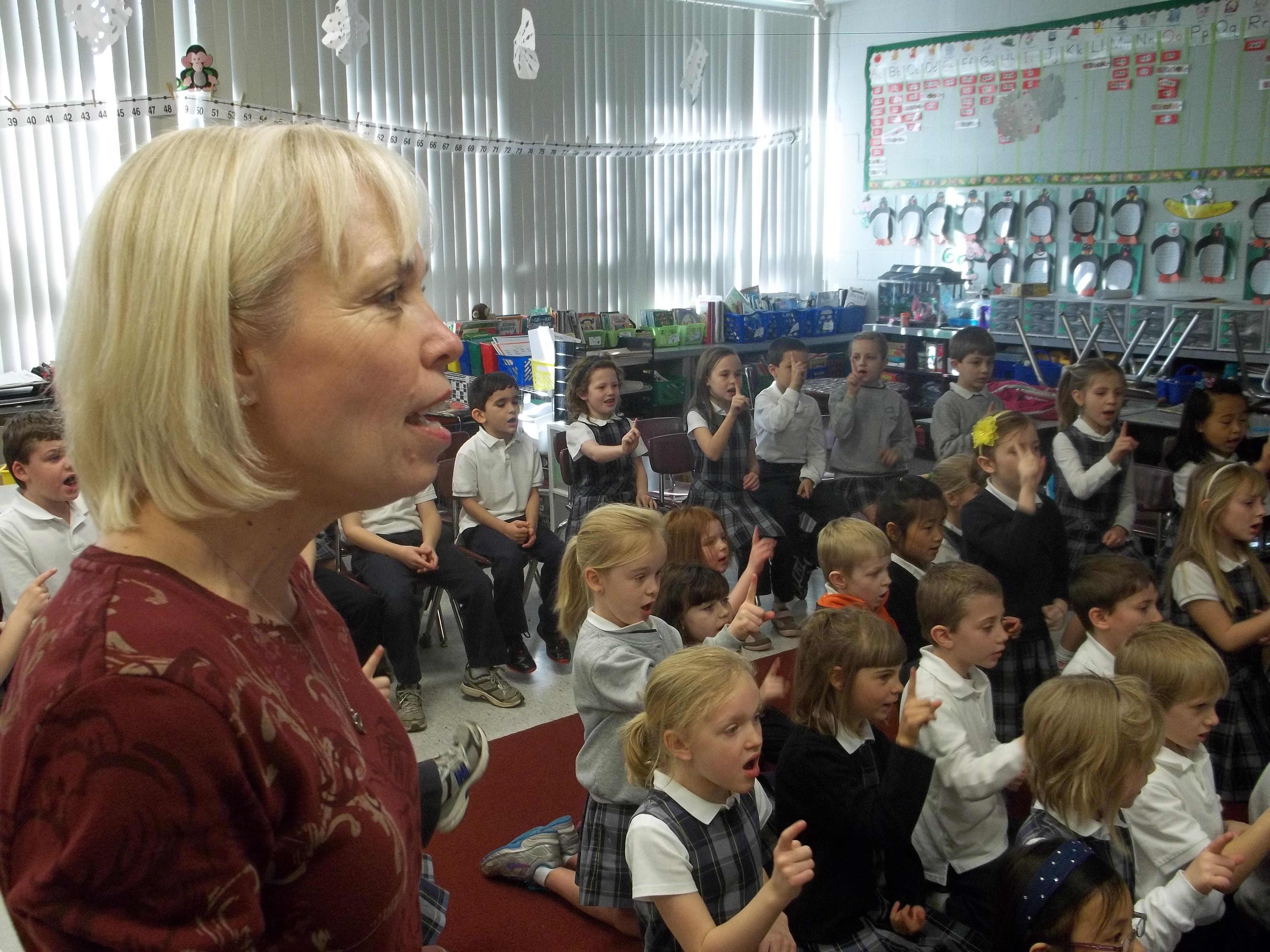
When it was our turn, the CD player went on, and our friends in Palestine heard, “All you works of God / Every mountain, star and tree / Bless the One who shapes your beauty / Who has caused you all to be / One great song of love and grace / Ever ancient, ever new / Raise your voices, all you works of God.”

Mrs. Phillips sang.

The children sang and made hand gestures that expressed the words of the song.

The  Arab children clapped with as much enthusiasm and appreciation as our children did.

They asked questions …

… and waited for answers.

There were questions (and answers) about snow, favorite sports, how old they were.

At the end of the visit, Mrs. Phillips spoke with the principal, Miss Abeer, who personally visited Mrs. Phillips classroom back in October. In June, Mrs Phillips goes to Miss Abeer’s school – and the circle of friendship will be complete.

with tears and prayers

2 Mar

محادثة “skype” مع مدرسة “Saint Andrew”

1 Mar

On February 28 students from Saint Joseph School in Nablus, in the West Bank of Palestine, visited by Skype with 6th graders from St. Andrew-St. Elizabeth Ann Seton school in Milford, Ohio.

Students from the two Catholic schools were 6,000 miles away, but technology brought them together to see each other’s smiles and to hear each other’s voices.

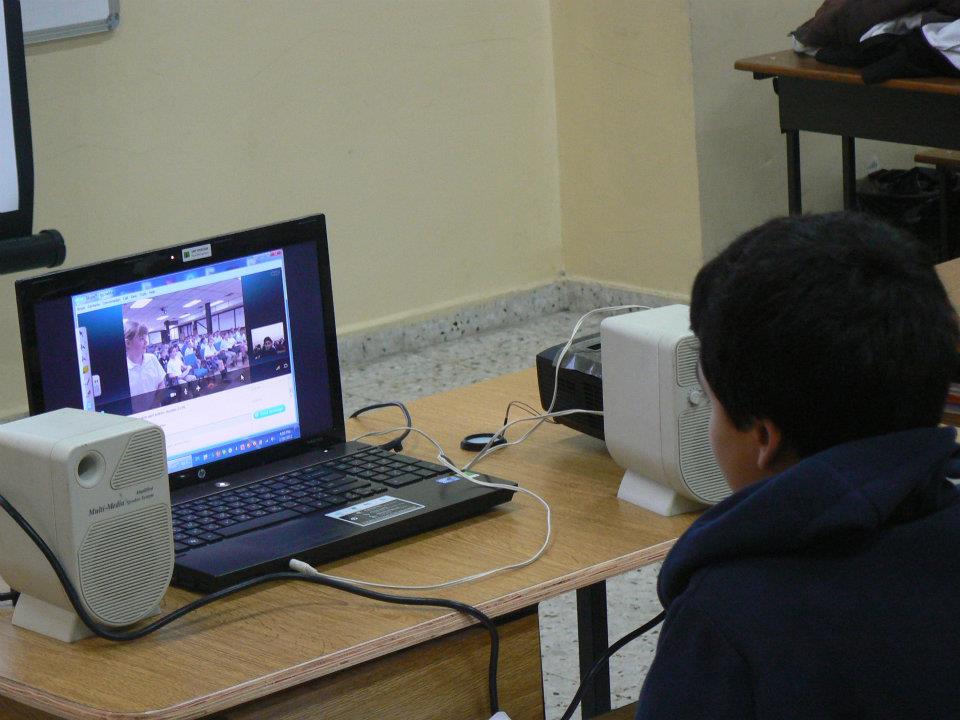
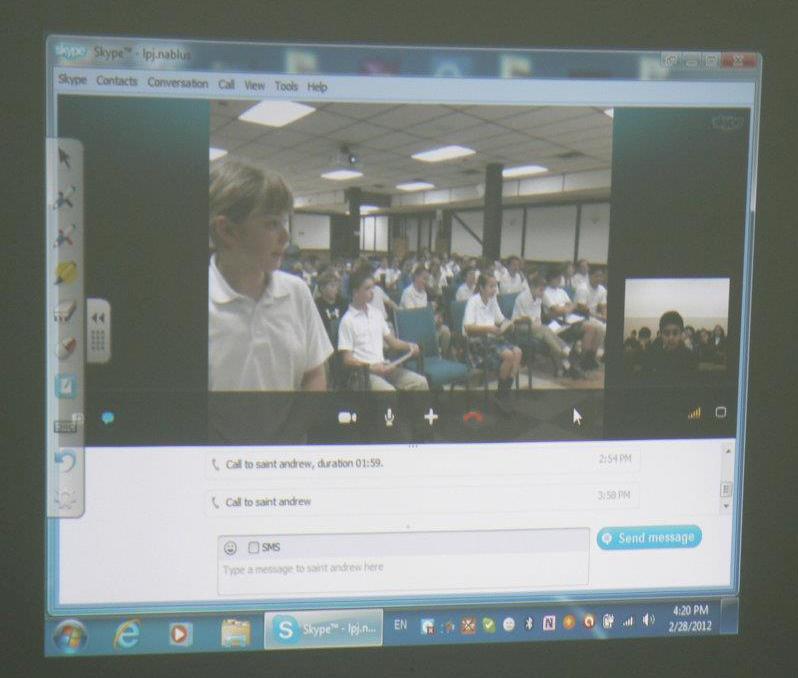
As one of the Palestinian students sat close to the computer, the others in the classroom watched on a large screen. They saw our students sitting in the hall below our church. Note in the bottom right corner of the next photo: in Palestine it was 420 p.m. The students had finished their school day, had gone home to eat the main meal of the day, and returned, yes, returned to school in order to meet our students who were just beginning their school day at 9:20 a.m.

In the classroom with the students …

… were Miss Abeer, their Principal, and Miss Ruya, their English teacher. Both Miss Abeer and Miss Ruya had visited our school last October. Our 6th grade teacher at St. Andrew, Mrs. Barbara Ambs, worked out the details of the online visit with Miss Ruya. They each prepared their own students, and pulled off this miracle visit, not giving up, even after technological problems forced them to cancel the first two attempts.

And look who else was in the classroom in Nablus: Father Johnny, the parish priest of St. Joseph.

A Palestinian girl asked her question. She spoke in English. She and her classmates began studying English in the first grade – and French, too. Notice the piece of paper. Isn’t that cute? She had her question ready.

Then she smiled, as she got an answer from her new American friend, who also spoke in English, of course. It would have been a very short visit and conversation, if our students needed to speak in Arabic.

It was fun for all: students, teacher and parish priest – on both sides.

This smile says it all. It’s for the children!

“We are not killing, fighting, just praying”

27 Feb

One day I will celebrate Mass on a Friday afternoon in an olive grove in Beit Jala with Father Ibrahim Shomali in prayerful protest of the land confiscation and the building of the separation wall at the Cremisan monastery, ensha’allah (God willing). 

Father Shomali is the parish priest of the Catholic Church of the Annunciation, in which I have celebrated Mass on several occasions. I have enjoyed the hospitality of the Latin Patriarchate seminary, which is connected to the parish church in Beit Jala, and at which I have been honored to speak to the new seminarians under the care of Father Faysal Hijazeen shortly after their arrival for the new school year. I have visited the children and teachers at the Latin Patriarchate School on numerous occasions, and in 2008 I was humbled and delighted with an invitation to address the high school graduates and their families at the graduation ceremony on the outdoor plaza overlooking Bethlehem. I have walked from the Beit Jala parish to the Cremisan monastery to buy wine to bring home with me. I know Beit Jala. I know the people of Beit Jala and I know Father Ibrahim, and am blessed to be able to call them my friends.

They need my prayers – and yours! They deserve my attention – and yours! 

At the Friday afternoon Mass they are not killing, fighting – just praying.