Archive | Christians in the Holy Land RSS feed for this section

In Miss Eman’s Own Words and Language

22 Dec

Below is an account of the December 20, 2011 “visit’’ (by way of Skype) between the 3rd grade class of Miss Eman in Beit Jala and the 4th grade class of Mrs. Schweickart in Milford. 

Miss Eman wrote this account, which is online at the parish website of the Church of the Holy Family, Ramallah, Palestine, the Holy Land – Pastor: Father Faisal Hijazin. It can be found here.

لقاء عبر الانترنت بين مدرسة البطريركية في بيت جالا ومدرسة القديس أندرو في أمريكا

 2011-12-22 02:59

   ضمن برنامج التوأمة مع مدرسة القديس اندرو في ولاية اوهايو في الولايات المتحدة الأمريكية ومدرسة البطريركية اللايتينة في بيت جالا جرى يوم الثلاثاء 20/12/2011 أول لقاء عبر الانترنت باستخدام برنامج Skype وهو اللقاء الأول من نوعه جرى في مدارس البطريركية للصفي الثالث الاساسي في المدرسة في بيت جالا وطلاب الصف الرابع من مدرسة سانت اندرو..

وقد تم التغلب على مشكلة الوقت التي واجهت طاقم التحضير لهذا فقد جرى هذا اللقاء في الساعة الرابعة عصرا حسب التوقيت الفلسطيني والساعة التاسعة صباحا حسب التوقيت في ولاية اوهايو وقد تبادل الطرفان الأسئلة حول كيفية التدريس والوقت والحياة المدرسية والاجتماعية من كلا الطرفين وأيضاً تم القاء بعض الأسئلة من كلا الطرفين والإجابة عليها.

 وفي آخر اللقاء تم تبادل تهاني عيد الميلاد المجيد بين الطلاب الصفين وأيضاُ قام طلابنا بتقديم ترتيلة لعيد الميلاد فيا للغة العربية وهم بدورهم رتلوا لعيد الميلاد باللغة الانجليزية.

وقتم تعليمهم بعض الكلمات في اللغة العربية مثل عيد ميلاد وسعيد وغيرها وتم الاتفاق على أن يتم اعاد مثل هذه اللقاءات في المستقبل لما له من آثار ايجابية على الطرفين.
وقد اشرف على تجهيز تقنيات هذا للقاء الاستاذ وسيم كسابرة من مدرسة البطريكية اللاتينية في بيت جالا مسؤول قسم الحاسوب وتكنولوجيا المعلومات في المدرسة بالإضافة الى المعلمة ايمان عمرو معلمة اللغة العربية للصف الثالث التي قامت بتحضير الطلاب لهذا اللقاء وايضاً المعلمة روجيس قمصية المسؤولة الاكاديمية في الادارة العامة لمدارس البطريركية اللاتينية وكذلك الاستاذ سهيل دعيبس من الادارة العامة وبحضور معلمة اللغة الانجليزية المعلمة سهيلة صليبي للصف الثالث ايضاَ.

نتمنى الاستمرار لمثل هذه اللقاءات لسماع الصوت الفلسطيني وسماع الصوت المسيحي لكافة ارجاء العالم .

Were we the only school in the U.S. that “skyped” with Bethlehem today?

20 Dec

The 4th graders from our St. Andrew-St. Elizabeth Seton school visited with the 3rd graders from the Latin Patriarchate School in Beit Jala (Bethlehem), Palestine. Speaking with children in Bethlehem right before Christmas – how cool is that! 

These Palestinian children live in Bethlehem. They are Christians – just like us – in a Catholic school – just like ours. 

There is Miss Eman, their teacher. When she was in the classroom with our students at our school in November, her face just lit up. She makes her students smile.  

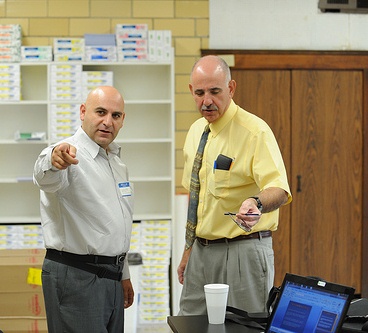
This is Mr. Waseim, their computer teacher. He is very clever – and very computer savvy. He has been to our school, too.  

 They sang “Jingle Bells” in Arabic. We clapped for them. 

We sang “Silent Night” in English. They clapped for us.  

It was a wonderful Christmas gift for me to be able to see and hear my two worlds, my two loves – Milford and Beit Jala – come together at Christmas.  

Mrs. Schweickart is our teacher. Last summer she went to the Beit Jala school, where she met Miss Eman and Mr. Waseim. In November she welcomed them to our school.  

We hope to visit again, by skype and in person. Ensha’allah. God willing. 

Women of Nazareth, Women of Hope: Basma, Hala and Mary

9 Dec

On yesterday’s Solemnity of the Immaculate Conception we heard Luke’s proclamation: “In the sixth month, the angel Gabriel was sent from God to a town of Galilee called Nazareth …”

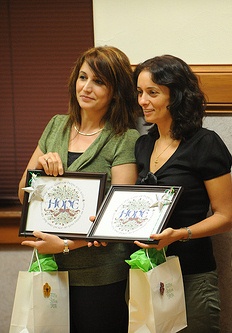
Hearing Gabriel’s greeting to Mary of Nazareth, I cannot help but send a greeting to two other women of Nazareth: Basma and Hala. These two extraordinary Christian women are counsellors in Catholic schools in Nazareth. Hala and Basma visited Cincinnati with other teachers from Latin Patriarchate schools from the West Bank and from Jordan, as part of a project called HOPE: Holy Land Outreach to Palestinian Educators. They are pictured below receiving gifts at the Farewell Dinner, in a photo taken by Mark Bowen.

Mary of Nazareth, responding to God’s desire and invitation to enter our world as one like us, brought Hope into the world, translate, brought Jesus, who is our hope, our only hope, into the world.

Basma and Hala, women of Nazareth, responding to God’s desire and invitation to bring reconciliation and justice into our world, bring hope to their students and build opportunities and dignity into their lives.

Beneath the Basilica of the Annunciation, in their beloved hometown of Nazareth, Basma and Hala visit often the grotto of the Annunciation, the very place of the conversation between God’s angel and God’s mother.In this place, as Mary did, so Hala and Basma respond with, “Behold, I am the handmaid of the Lord. May it be done to me according to your word.”

Greetings, Basma and Hala. The Lord is with you. Blessed are you among women. May the angel never depart from you.

Longing for Hope, Many Despair

5 Dec

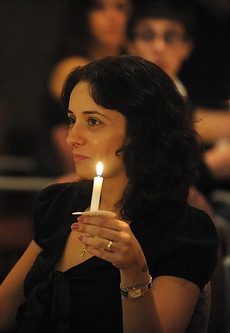
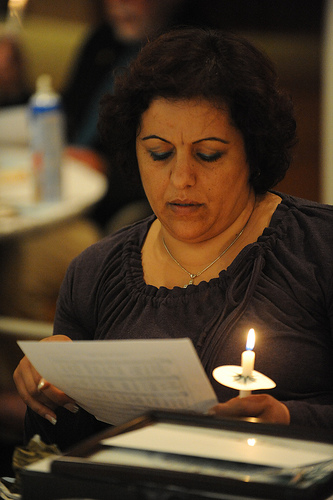
At the closing prayer of our farewell dinner, with the lights in the room dimmed and candles burning, the Light of Christ shone brightly among us and within us, as we sang with Hala from Nazareth, Rogeece from Beit Sahour, Suhail from Zebabdeh, Waseim from Beit Jala, and Ruya from Nablus. They are teachers. They are Palestinians. They are Christians. They are our friends. They are brothers and sisters in Christ.

Christ, be our light! Shine in our hearts.
Shine through the darkness.
Christ, be our light!
Shine in your church gathered today.


Longing for light, we wait in darkness.
Longing for truth, we turn to you.
Make us your own, your holy people,
light for the world to see.

Longing for peace, our world is troubled.
Longing for hope, many despair.
Your word alone has pow’r to save us.
Make us your living voice. 

Longing for food, many are hungry.
Longing for water, many still thirst.
Make us your bread, broken for others,
shared until all are fed.Longing for shelter, many are homeless.
Longing for warmth, many are cold.
Make us your building, sheltering others,
walls made of living stone.

Many the gifts, many the people,
many the hearts that yearn to belong.
Let us be servants to one another,
making your kingdom come. 

Christ, be our light! Shine in our hearts.
Shine through the darkness.
Christ, be our light!
Shine in your church gathered today.

“It was kind of you to share in my distress”

1 Dec

A people without hope perish.

A program called HOPE – Holy Land Outreach to Palestinian Educators – brought Christians teachers together. They teach in Catholic schools, in Cincinnati and in the Holy Land. What they have in common is that they teach children – and they teach with hope.

During the visit of our friends from the West Bank, Israel and Jordan, we prayed in many places and at many times.

We prayed on a Sunday with the people of St. Andrew parish, Milford …

We prayed on a school day with the children of St. Lawrence school, Price Hill …

We prayed with the Sisters of Charity at their motherhouse, Delhi …

Having heard the personal stories of our Jordanian and Palestinian friends, and having shared in their struggles and sufferings as teachers, parents, citizens and believers living as a minority in their lands, we celebrated a last Mass together before they left toward home. Be in awe – and be filled with hope – as you read what was proclaimed at that Mass from St. Paul’s Letter to the Philippians, noting that the reading was not specifically chosen for the occasion but “just happened” to be the reading permanently assigned to that day in the Church’s established calendar of readings:

“Brothers and sisters:  I know how to live in humble circumstances; I know also how to live with abundance. In every circumstance and in all things I have learned the secret of  being well fed and of going hungry, of living in abundance and of being in  need. I can do all things in him who strengthens me. Still, it was kind of you to share in my distress. My God will fully supply  whatever you need, in accord with his glorious riches in Christ Jesus. To our  God and Father, glory forever and ever. Amen.”

We got what it takes!

1 Dec

What does it take to begin a partnership between St. Andrew-St. Elizabeth Ann Seton School in Milford and the Latin Patriarchate School in Beit Jala?

passion for learning

love of children

hope and gratitude

desire and longing

talent and faith

… and …

SASEAS principal, Tom

Beit Jala teacher, Eman          Beit Jala teacher, Waseim

… and …

the “techies” – Waseim (LPSBJ) … George (SASEAS) 

… and …

the “teachers” – Sue (America) … Eman (Palestine)

What does it take to build and continue a partnership between our SASEAS and their LPSBJ?

passion for learning

love of children

hope and gratitude

desire and longing

talent and faith

Eman … Tom … Waseim … George … Sue

We got what it takes!

No Hatred or Violence, Please

30 Nov

Archbishop Chacour (CNS/Paul Haring)

In her October 25 article on the Catholic News Service website, Deborah Gyapong begins by noting that Melkite Archbishop Elias Chacour is Palestinian, an Arab, a Christian and an Israeli citizen, and that he is proud of each one of his identities.

Here are snippets of the piece by Ms. Gyapong: 

  • “We have been labeled a nation of terrorists,” he said. “We have been a nation terrorized for over 70 years.” 
  • If people sympathize with the suffering of Palestinians in refugee camps, or struggling under the occupation in Gaza or the West Bank, or as second-class citizens in Israel, they might decide “to be on our side,” he said. “If being on our side with the Palestinians, being for us, means being against the Jews, we do not need your friendship,” he said. “You reduce yourselves to being one more enemy.”  
  • Archbishop Chacour said his parents taught him never to hate, even though, when he was 8, the Israeli military ordered his family to leave their home in their ancestral village. Expecting to be allowed to return, his family and other villagers lived for two weeks in the hills. Then the family heads went to speak with Israeli authorities about returning to their homes. Instead of inviting them back, the military herded them onto military trucks “like cattle” and dropped them off across the border at Nablus, West Bank, and told them not to return. 
  • In 1953, his home village was razed and the land confiscated by the Israeli government, he said. But he does not use these experiences as a pretext for hatred or violence. Instead, he has devoted his life to reconciliation and building peace among Jews, Christians and Muslims. 
  • “We Palestinians and Jews do not need to learn how to live together,” he said. “We just need to remember how we used to live together for centuries and centuries.”

Read the entire article here: “Melkite archbishop urges Christians to support Jews and Palestinians.”

“Keep my spirit, until I come back”

29 Nov

At the farewell dinner the night before the Christian teachers from the Holy Land left us to fly back home, Rogeece, in the name of the group, presented me with a piece of olive wood in the shape of a heart. This is how she explained the gift: 

When we were at the Freedom Center, I watched a six-to-seven minute video about a young boy who was from a slave family. He was escaping, in order to look for freedom, and then return to his family. His hope was to bring back freedom for all of them. When the young boy was about to say goodbye to his mother and his young sister, he gave them a heart-shaped stone. Handing his heart to his sister, he said, “Keep my spirit, until I come back.” He meant to come back as a human being, with all his rights and dignity, to give freedom to all of them.

As we leave Cincinnati, we give a heart-shaped piece of olive wood to you, our father, and to our sisters and brothers that we leave behind. We ask you to keep our spirit, until we get peace in our land, the Holy Land, until we live with our families in peaceful and just conditions, and until we return with dignity.

I will keep your heart close to my heart, Rogeece. I will keep your spirit, until you come back.

In the Olive Garden with Ibrahim

10 Nov

Below is an article about Father Ibrahim Shomali and the Christians of Beit Jala. It appears on the website of the Latin Patriarchate Jerusalem (the Roman Catholic Archdiocese of Jerusalem).

Father Ibrahim is the parish priest of Annunciation Church in Beit Jala. St. Andrew parish is in a twinning relationship with his parish, and our SASEAS school is in a twinning relationship with his parish school. Father Ibrahim will be visiting us in Milford in December, and will be with us for Sunday Mass, ensha’allah. Next June I will visit him in Beit Jala, and will celebrate Mass with him in the olive field of Beit Jala, God willing.

Beit Jala Christians pray to stop wall

Christians of Beit Jala attended an open-air Mass on Friday, November 4th to pray together against the Israeli decision to confiscate a part of their land. The Israeli government intends to extend the separation wall at the entrance of the Cremisan valley.

To protest against this decision, faithful gathered with the Pastor of Beit Jala, Father Ibrahim Shomali and Father Mario Corniole for an open-air Mass. An Israeli committee approved a plan to build 1,100 new houses on the south slopes of Gilo last September. To do this, the route of the wall “will confiscate land belonging to Christian people and Christian church,” reports a statement of the Latin parish. The idea is simple: protesting not by violence but by prayer. In the same statement, the parish priest and Christians of Beit Jala denounce “the  confiscation [by Israel] of the last green area in Beit Jala (Bethlehem district)”, considering “the annexation of the most beautiful lands in the Bethlehem area as a direct attack against the Palestinian people and especially  against Palestinian Christians.”

Soliciting members of the Quartet for the Middle East – including the United Nations, the Russian Federation, the United States and the European Union – and also calling upon the rest of the international community, the parish of Beit Jala called President Mahmoud Abbas’ government, the Latin Patriarchate and the civil society to do “everything possible to keep the land in the hands of its rightful owners.”

In the light of the message from Synod for the Middle East last year regarding the Christian presence in the Holy Land: “It is Church’s duty to support our presence. Therefore, we call the Holy See and Pope Benedict XVI to act  immediately, using all possible means to help protect our people.”

The Mass was celebrated in a field of olive trees which will probably be cut and uprooted. As recalled by Father Mario Corniole, olives were silent witnesses of Jesus’ suffering and agony in Gethsemane. Thus, Beit Jala parishioners attached to their land and their olive trees will meet every Friday on this “Gethésménai” where they still live in fear, but also with the hope that their land will always be respected.

آمين‎ and Amen

23 Oct

The message was one of HOPE. The prayer was for PEACE.

This time the children of our Catholic school at St. Andrew-Saint Elizabeth Ann Seton prayed the rosary not just “for” our sisters and brothers in the Holy Land. They prayed “with” their brothers and sisters of the Holy Land, during the visit of four Palestinian teachers from the Holy Land.

Each decade of the rosary on the wall and in their hands was a different color. For each decade there was a different intention and reflection. 

The first mystery of the five decade rosary was the “Visit of the Magi.” The color was green. The symbol was hope. The language was English.

The second mystery was “Jesus Speaks with the Samaritan Woman.” Appropriately, it was prayed in Arabic by the teacher from Nablus, the site of Jacob’s well, from which the teacher and her students still drink. The symbol was peace and unity; the color was blue.

Back to English, the third mystery, “Jesus Cures the Centurion’s Servant,” with white being the color, carried with it a message of healing, light and understanding.

The teacher from Beit Jala (Bethlehem) led the fourth mystery, “Jesus Sends Out His Disciples,” with its symbol of the Holy Spirit and its color of red.

The children finished with the fifth mystery in English, “The Conversion of Paul.” The yellow beads of the decade brought with them thoughts of optimism and joy.

At the end of each Our Father, Hail Mary and Glory Be there was an Amen, heard in English and in Arabic. The sound of “Amen” in English is not much different from the sound of “Ameen” in Arabic. In the praying, the children realized that the teachers from the Holy Land were not much different from the teachers in their own classrooms. The visiting teachers probably saw in the faces and voices of our students the hopes and dreams of their own students back home in Nablus and Beit Jala.  

آمين and Amen.